Limebug technical reference
This reference consolidates Volkswagen dealer data, workshop/manual information and specialist hardware records into one torque guide. All torque values are shown in both ft-lb and Nm. Nm figures are calculated at 1 ft-lb = 1.355817948 Nm and rounded to one decimal place.
Aircooled VW coverage through 1979
This guide is organised by Volkswagen model family first, then by mechanical system. Where different models share the same factory engine, gearbox or fastener, the shared specification is stated once and the model section points to it. Market-specific body hardware should always be matched by part and year.
Worldwide derivatives: Brazilian and other market-built aircooled Volkswagens through 1979 are best matched by the exact drivetrain and fastener fitted. Shared Type 1/Type 2/Type 3 hardware is covered here; market-only body and chassis fasteners should not be inferred solely from model appearance.
General fastener dimensions & hardware details
Where a property class, head style, seat, shoulder or exact length is known for the specific VW fastener it is shown here. A dash means the detail is not needed to apply the torque figure safely or varies by exact production hardware; it is not a recommendation to substitute any grade.
VW workshop torque tables often identify diameter and pitch but not bolt length or wrench size. The following physical details are from current specialist hardware listings or VW dealer data and are therefore kept separate from generic assumptions.
| VW part / reference | Component | Dimensions | Grade / construction | Features | Model / years |
|---|---|---|---|---|---|
| 111 513 475A | Front upper / rear lower shock bolt | M12×1.5×90 mm | 10.9 | DIN 960 fine thread high-tensile | Split Screen Type 2 63–67; swing-axle Beetle rear lower; other VW applications |
| 111 413 403A | Rear upper shock bolt | M12×1.5×65 mm | 10.9 | DIN 960 fine thread high-tensile | Split Screen Type 2 55–67; selected Beetle/Type 3 shock applications |
| 211 499 001A | Front axle mounting bolt kit | Size varies by supplied kit | 12.9 | High-tensile front beam mounting hardware | Split Screen Type 2 / Bay Window 1968–79 |
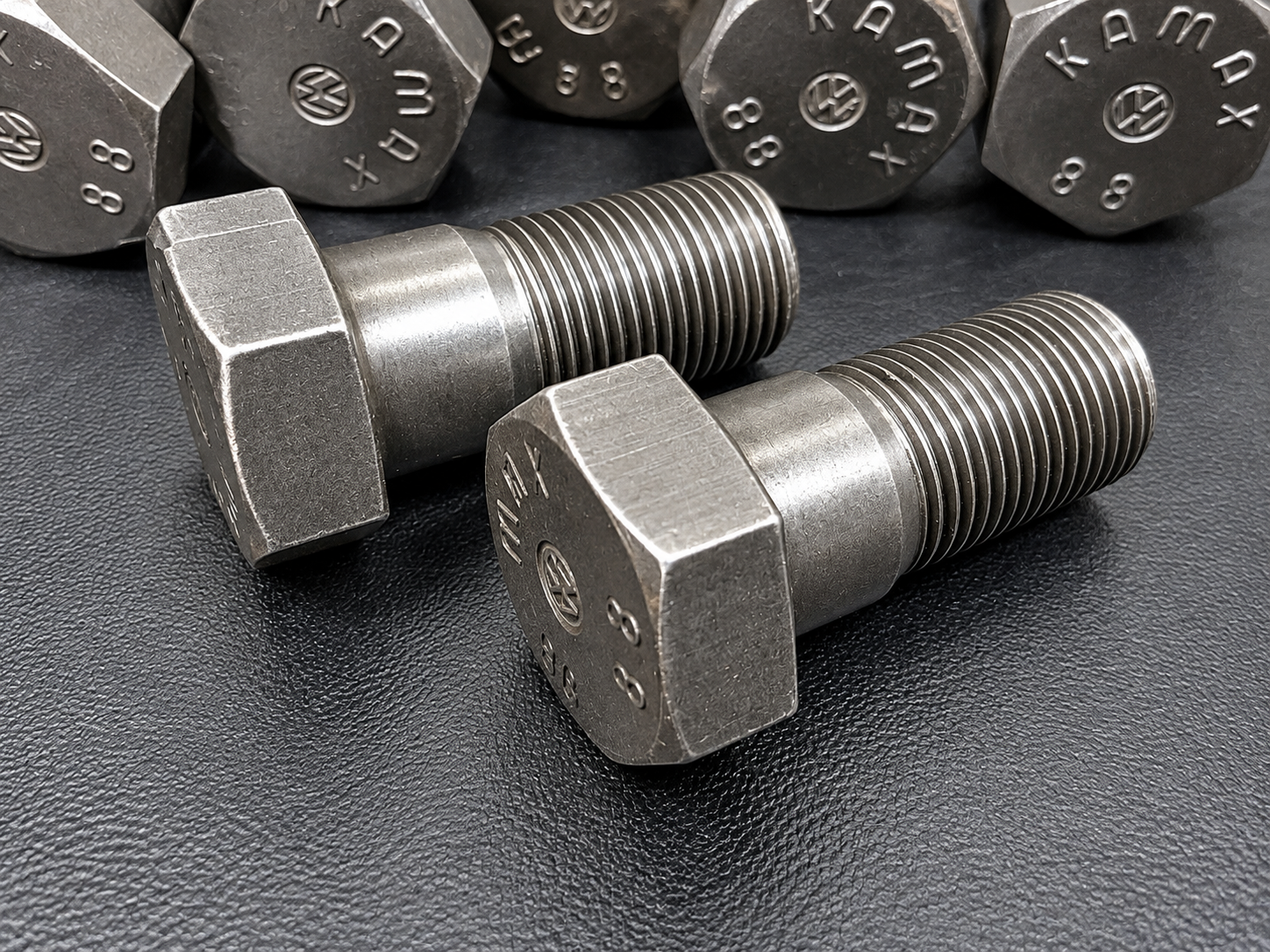
| 111 601 139 / early wheel bolt | Wheel bolt | M12×1.5 × 26 mm shank | — | 17 mm hex · radius seat · metric fine | Early Beetle / Karmann Ghia / Type 3 |
All torque grids use the same field order: component first, then model / years, then fastener details where they are known, followed by ft-lb and Nm. A fastener column is omitted entirely when the section has no verified fastener data, rather than filling it with empty values.
Model-specific torque sections
Type 1 Beetle & Cabriolet through 1979 / Karmann Ghia Type 14 1955–74
Early Type 1 engine — 30 bhp and 34/42 bhp factory reference
| Component | Model / years | Fastener / details | ft-lb | Nm |
|---|---|---|---|---|
| Crankcase halves — large nutsEarly 30 bhp exception. | 30 bhp engine | M10 | 22 | 29.8 |
| Crankcase halves — large nuts | 34 / 42 bhp engine | M12×1.5 | 25 | 33.9 |
| Crankcase halves — small nuts / bolts | 34 / 42 bhp engine | M8 | 14 | 19.0 |
| Cylinder head nutsTighten progressively in sequence. | 30 bhp engine | M10 | 26–27 | 35.3–36.6 |
| Cylinder head nutsTighten progressively in sequence. | 34 / 42 bhp engine | M10 | 23 | 31.2 |
| Rocker shaft nuts | 34 / 42 bhp engine | M8 | 14–18 | 19.0–24.4 |
| Flywheel gland nut | 34 / 42 bhp engine | M28×1.5 | 217 | 294.2 |
| Connecting rod bolts | 34 / 42 bhp engine | M9×1 | 29–36 | 39.3–48.8 |
| Fan nut | 34 / 42 bhp engine | M12×1.5 | 40–47 | 54.2–63.7 |
| Generator pulley nut | 34 / 42 bhp engine | M12×1.5 | 40–47 | 54.2–63.7 |
| Crankshaft pulley bolt | 34 / 42 bhp engine | — | 29–36 | 39.3–48.8 |
| Spark plugs | 34 / 42 bhp engine | M14×1.25 | 22–29 | 29.8–39.3 |
| Oil drain plug | 34 / 42 bhp engine | M14×1.5 | 25 | 33.9 |
| Oil drain plug | 30 bhp engine | M18×1.5 | 22–29 | 29.8–39.3 |
| Spark-plug insert | 30 bhp engine | M18×1.5 | 50–54 | 67.8–73.2 |
Type 1 king & link-pin front axle — through 1965
| Component | Model / years | Fastener / details | ft-lb | Nm |
|---|---|---|---|---|
| Front axle / beam to frame bolts | Type 1 Beetle / Karmann Ghia — king & link pin | — | 36 | 48.8 |
| Steering knuckle / torsion-arm link-pin pinch bolts | Type 1 Beetle / Karmann Ghia — king & link pin | M10 | 29–32 | 39.3–43.4 |
| Torsion-bar set screw and locknut | Type 1 Beetle / Karmann Ghia — king & link pin | — | 33 | 44.7 |
The broad system tables later in this guide are the main reference for Beetle and Type 14 Karmann Ghia mechanical torque. Match the year and front-suspension type before use: standard Beetles and Ghias use the torsion-beam data, while 1302/1303 Super Beetles use the separate MacPherson-strut table.
Split Screen Type 2 1950–67 (German-built)
| Component | Model / years | Fastener / details | ft-lb | Nm |
|---|---|---|---|---|
| Front axle to frame side member | Split Screen Type 2 — factory reference | M12×1.5 | 72–80 | 97.6–108.5 |
| Upper / lower steering arm bolt — early chassis | Split Screen Type 2 — early | M12×1.5 | 47–54 | 63.7–73.2 |
| Swing-lever bolt — later chassis | Split Screen Type 2 — later | M12×1.5 | 43 | 58.3 |
| Drop arm nut | Split Screen Type 2 | M20×1.5 | 58–72 | 78.6–97.6 |
| Steering gear bracket to frame | Split Screen Type 2 | M10 | 29–32 | 39.3–43.4 |
| Steering gear to bracket | Split Screen Type 2 | M10 | 29–32 | 39.3–43.4 |
| Steering damper to axle tube | Split Screen Type 2 — later | M10 | 29–32 | 39.3–43.4 |
| Steering damper to swing lever | Split Screen Type 2 | M10 | 29–32 | 39.3–43.4 |
| Tie-rod end to steering knuckle / swing leverCastellated/slotted nut: continue only as required for split-pin alignment where specified. | Split Screen Type 2 | M10×1 | 18 | 24.4 |
| Drag-link end nutsCastellated/slotted nut: continue only as required for split-pin alignment where specified. | Split Screen Type 2 | M10×1 | 18 | 24.4 |
| Steering knuckle to torsion arm link-pin bolts | Split Screen Type 2 | M10 | 29–32 | 39.3–43.4 |
| Front shock absorber upper — early | Split Screen Type 2 — early | M10 | 29–32 | 39.3–43.4 |
| Front shock absorber upper — later | Split Screen Type 2 — later | M12×1.5 | 50–58 | 67.8–78.6 |
| Front shock absorber lower | Split Screen Type 2 | M10 | 18–22 | 24.4–29.8 |
| Rear axle shaft nut — early Type 2 | Split Screen Type 2 — early | M24×1.5 | 217 | 294.2 |
| Rear axle shaft nut — later Type 2 | Split Screen Type 2 — later | M30×1.5 | 217–253 | 294.2–343.0 |
| Reduction-box driven-shaft nut | Split Screen Type 2 — Aug 1963 onward | M30×1.5 | 108 | 146.4 |
| Spring plate to reduction gearbox screws | Split Screen Type 2 | M12×1.5 | 72–87 | 97.6–118.0 |
| Transmission carrier to frame | Split Screen Type 2 | M18×1.5 | 166 | 225.1 |
| Wheel bolts | Split Screen Type 2 | M14×1.5 | 87 | 118.0 |
| Front brake backplate / wheel-cylinder mounting | Split Screen Type 2 | M10 | 40–43 | 54.2–58.3 |
| Rear bearing cover to brake backplate | Split Screen Type 2 | M10 | 40–43 | 54.2–58.3 |
| Brake hose / pipe union | Split Screen Type 2 | M10×1 | 10–14 | 13.6–19.0 |
| Brake-light switch | Split Screen Type 2 | M10×1 | 10–14 | 13.6–19.0 |
These are Split-specific values and hardware details that could be verified cleanly from VW dealer references and specialist replacement hardware records. This section is intentionally narrower than the Beetle master table rather than filling gaps with assumptions.
Type 2 Bay Window 1968–79 (German-built)
Bay Window running gear changed substantially across production. Use this section for Bus-specific chassis, steering and suspension values, and identify the engine/gearbox family before using engine or transmission torque data.
| Years | Engine | Gearbox | Key change | Torque reference |
|---|---|---|---|---|
| 1968–70 | 1600 Type 1 upright | 002 manual | Single-port era | Match Type 1 engine fastener/year data; use Bay chassis table below. |
| 1971 | 1600 Type 1 upright | 002 manual | Dual-port; front disc-brake year change | Match 1600 Type 1 engine data; use Bay chassis table below. |
| 1972–73 | 1.7 L Type 4 | 002 manual | Type 4 engine introduced | Do not substitute Type 1 engine torque for Type 4 engine internals. |
| 1974–75 | 1.8 L Type 4 | 002 manual | 1.8 L Type 4 | Use Bay chassis table; engine-specific Type 4 values require the matching engine data. |
| 1976–79 | 2.0 L Type 4 | 091 manual | Later 2.0 L drivetrain | Use Bay chassis table; do not apply earlier 002/Type 1 assumptions. |
Type 2 Bay Window chassis, steering & suspension
| Component | Model / years | Fastener / details | ft-lb | Nm |
|---|---|---|---|---|
| Wheel bolts | Type 2 Bay Window | M14×1.5 | 94 | 127.4 |
| Wheel nuts | Type 2 Bay Window — where fitted | — | 101 | 136.9 |
| Front axle mounting bolts to frame | Type 2 Bay Window | — | 65–90 | 88.1–122.0 |
| Steering damper to axle tube | Type 2 Bay Window | M10 | 29–32 | 39.3–43.4 |
| Steering ball joint to knuckle | Type 2 Bay Window | — | 72 | 97.6 |
| Stabilizer to torsion arm | Type 2 Bay Window | — | 25–36 | 33.9–48.8 |
| Tie-rod end to steering knuckle | Type 2 Bay Window | — | 22 | 29.8 |
| Shock absorber to torsion arm | Type 2 Bay Window | — | 18–25 | 24.4–33.9 |
| Shock absorber to side plate | Type 2 Bay Window | — | 36 | 48.8 |
| Drop arm to sector shaft — slotted nutContinue only as required to align the split pin where specified. | Type 2 Bay Window | — | 58–80 | 78.6–108.5 |
| Tie-rod clamp bolt | Type 2 Bay Window | — | 11–14 | 14.9–19.0 |
| Drag link to drop armContinue only as required to align the split pin where specified. | Type 2 Bay Window | — | 14–22 | 19.0–29.8 |
| Drag link to swing leverContinue only as required to align the split pin where specified. | Type 2 Bay Window | — | 14–22 | 19.0–29.8 |
| Drag-link clamp | Type 2 Bay Window | — | 11–14 | 14.9–19.0 |
| Backplate to steering knuckle | Type 2 Bay Window | — | 36–43 | 48.8–58.3 |
| Steering gear to side member | Type 2 Bay Window | — | 25–36 | 33.9–48.8 |
| Diagonal arm to rear wheel-bearing housing | Type 2 Bay Window — later independent rear suspension | M14×1.5 | 94 | 127.4 |
| Diagonal arm to frame | Type 2 Bay Window — later independent rear suspension | M12×1.5 | 58 | 78.6 |
| Rear shock absorber to frame / bearing housing | Type 2 Bay Window — later | M12×1.5 | 43 | 58.3 |
| Drive shaft / flange socket-head screw | Type 2 Bay Window — later CV drivetrain | M8 | 25 | 33.9 |
| Spring-plate bushing cover | Type 2 Bay Window | M10 | 32 | 43.4 |
| Rear brake backplate to housing | Type 2 Bay Window — M8 hardware | M8 | 18 | 24.4 |
| Rear brake backplate to housing | Type 2 Bay Window — M10 hardware | M10 | 25 | 33.9 |
| Rear wheel hub / shaft castellated nutMinimum/preload procedures vary; follow the matching workshop procedure and split-pin alignment instruction. | Type 2 Bay Window — later | M30×1.5 | 253 | 343.0 |
| Steering wheel / column nut | Type 2 Bay Window | — | 36 | 48.8 |
Type 3 1961–73 & Type 34 1961–69 (German-built)
This table comes from Volkswagen’s January 1964 Without Guesswork Type 3 dealer reference. Type 34 Karmann-Ghia Coupé is explicitly included within the Type 3 model family in that publication.
| Component | Model / years | Fastener / details | ft-lb | Nm |
|---|---|---|---|---|
| Crankcase halves — large nuts | Type 3 / Type 34 — Jan 1964 factory reference | M12×1.5 | 25 | 33.9 |
| Crankcase halves — small nuts / bolts | Type 3 / Type 34 — Jan 1964 factory reference | M8 | 14 | 19.0 |
| Cylinder head nutsTighten progressively in the prescribed sequence. | Type 3 / Type 34 — Jan 1964 factory reference | M10 | 22–23 | 29.8–31.2 |
| Rocker shaft nuts | Type 3 / Type 34 — Jan 1964 factory reference | M8 | 18 | 24.4 |
| Flywheel gland nut | Type 3 / Type 34 — Jan 1964 factory reference | M28×1.5 | 217 | 294.2 |
| Connecting rod nuts | Type 3 / Type 34 — Jan 1964 factory reference | M9×1 | 36 | 48.8 |
| Fan / crankshaft pulley screw | Type 3 / Type 34 — Jan 1964 factory reference | M20×1.5 | 109 | 147.8 |
| Generator pulley nut | Type 3 / Type 34 — Jan 1964 factory reference | M12×1.5 | 33 | 44.7 |
| Spark plugs | Type 3 / Type 34 — Jan 1964 factory reference | M14×1.25 | 22 | 29.8 |
| Oil drain plug | Type 3 / Type 34 — Jan 1964 factory reference | M14×1.5 | 25 | 33.9 |
| Steering wheel nut | Type 3 / Type 34 — Jan 1964 factory reference | M18×1.5 | 29 | 39.3 |
| Steering gear to axle beam nuts | Type 3 / Type 34 — Jan 1964 factory reference | M10 | 18 | 24.4 |
| Torsion-arm locknut | Type 3 / Type 34 — Jan 1964 factory reference | M10×1 | 18 | 24.4 |
| Roller-shaft adjusting-screw locknut | Type 3 / Type 34 — Jan 1964 factory reference | M10×1 | 18 | 24.4 |
| Drop-arm mounting screw | Type 3 / Type 34 — Jan 1964 factory reference | M12×1.5 | 51 | 69.1 |
| Steering arm | Type 3 / Type 34 — Jan 1964 factory reference | M10×1 | 40 | 54.2 |
Type 3 / Type 34 chassis, brakes & front axle
| Component | Model / years | Fastener / details | ft-lb | Nm |
|---|---|---|---|---|
| Ball-joint clamping screw | Type 3 / Type 34 — Jan 1964 factory reference | M8×40 | 25 | 33.9 |
| Ball-joint nut | Type 3 / Type 34 — Jan 1964 factory reference | M18×1 | 80 | 108.5 |
| Torsion-bar / stabilizer mounting grub screw | Type 3 / Type 34 — Jan 1964 factory reference | M14×1.5 | 29 | 39.3 |
| Grub-screw locknut | Type 3 / Type 34 — Jan 1964 factory reference | M14×1.5 | 22 | 29.8 |
| Front axle bracket — upper / lower | Type 3 / Type 34 — Jan 1964 factory reference | M10 | 22 | 29.8 |
| Front axle bracket — centre | Type 3 / Type 34 — Jan 1964 factory reference | M10 | 29 | 39.3 |
| Brake backplate bolt | Type 3 / Type 34 — Jan 1964 factory reference | M10×1.5 | 40 | 54.2 |
| Brake wheel cylinder | Type 3 / Type 34 — Jan 1964 factory reference | M8 | 18–22 | 24.4–29.8 |
| Brake hose / pipe union | Type 3 / Type 34 — Jan 1964 factory reference | M10×1 | 11–14 | 14.9–19.0 |
| Bleeder screw | Type 3 / Type 34 — Jan 1964 factory reference | M10×1 | 3.5 | 4.7 |
| Wheel bolt | Type 3 / Type 34 — Jan 1964 factory reference | M12×1.5 | 72 | 97.6 |
| Body mounting bolt — M8 | Type 3 / Type 34 — Jan 1964 factory reference | M8 | 7–11 | 9.5–14.9 |
| Body mounting bolt — M10 | Type 3 / Type 34 — Jan 1964 factory reference | M10 | 11–14 | 14.9–19.0 |
| Subframe mounting bolt — M8 | Type 3 / Type 34 — Jan 1964 factory reference | M8 | 18 | 24.4 |
| Subframe mounting bolt — M10 | Type 3 / Type 34 — Jan 1964 factory reference | M10 | 33 | 44.7 |
Fridolin Type 147 1964–74
Period Type 147 literature identifies a 1192 cc / 34 PS engine, four-speed fully synchronised transaxle, swing axles, torsion-bar independent suspension and a front anti-roll bar. That makes many components recognisably Volkswagen, but there is not enough model-specific torque material in the accessible Type 147 owner literature to publish a fully independent Fridolin torque chart without cross-identifying each part number. For Fridolin work, use the matching Type 1/Type 2 torque only where the actual component and thread are confirmed.
Type 181 / Thing / Trekker 1969–79 reference
The Type 181 uses the Type 1 engine family but its suspension and rear drivetrain are not simply a Beetle copy. Early vehicles use a swing-axle/reduction-box rear arrangement; later vehicles use IRS. The upper front ball joint/eccentric hardware is also Type 181-specific.
Type 181 commonly serviced torque settings
| Component | Model / years | Fastener / details | ft-lb | Nm |
|---|---|---|---|---|
| Pitman / drop-arm clamping bolt | Type 181 — ball-joint front | — | 51 | 69.1 |
| Steering coupler fasteners | Type 181 — ball-joint front | — | 22 | 29.8 |
| Steering box clamp to beam | Type 181 — ball-joint front | — | 22 | 29.8 |
| Rear axle / hub castellated nutContinue only as required for cotter-pin alignment; do not back off to align. | Type 181 — 1973–74 IRS civilian specification | M24×1.5 · 36 mm castellated nut | 253 | 343.0 |
| Flywheel gland nut | Type 181 — original 1600 Type 1 engine | M28×1.5 | 253 | 343.0 |
| Clutch pressure plate to flywheel | Type 181 — original 1600 Type 1 engine | M8 | 18 | 24.4 |
Type 4 411 / 412 1968–74 (German-built)
Type 4 cars use a distinct engine, transmission and independent rear suspension. Their engine torque figures also apply to the corresponding Type 4 engine family used in 1972–79 German-built Bay Windows when the same fastener and engine version are fitted.
Worldwide aircooled Volkswagen derivatives through 1979
Regional Volkswagen models are included by mechanical family and fitted hardware. A shared German torque value is only applicable when the engine, gearbox, suspension, brake or fastener is the same specification. This avoids creating false certainty simply because two cars share a Volkswagen badge or aircooled engine layout.
Brazilian-built aircooled Volkswagens through 1979
Mexican-built Type 1 / Sedan through 1979
Mexican Beetle production continued with Type 1 mechanical architecture but did not always follow German year changes at the same time. Use the Type 1 engine, torsion-beam, brake and transaxle tables by the actual fitted hardware and engine generation, not the German model year alone.
Regional model-to-system map
| Model | Years in scope | Engine family | Chassis / drivetrain cue | Use these tables first |
|---|---|---|---|---|
| VW 1600 / TL / Variant | 1968–79 | Brazilian Type 3-derived aircooled flat engine | Confirm front axle, brakes and transaxle by component | Type 3 / Type 34, then shared system table |
| SP1 | 1972–76 | 1600 aircooled | Brazil-specific sports body and running gear | Type 3-derived/shared hardware only after verification |
| SP2 | 1972–76 | 1700 aircooled derivative | Brazil-specific sports body and running gear | Shared hardware where confirmed; do not assume 1600 internal engine torque |
| Brasilia | 1973–79 | 1584 cc aircooled | Torsion-bar front, swing-type rear, front disc/rear drum | Type 1/Type 3 shared systems by exact hardware |
| Brazilian Kombi | Through 1979 | Aircooled Type 1-family variants in this period | Late split-screen then bay-front production | Split or Bay chassis only after confirming actual hardware |
| Mexican Beetle / Sedan | Through 1979 | Type 1 | Torsion-beam Type 1 architecture with market-specific timing of changes | Type 1 engine/front axle/brakes/transaxle by fitted component |
System-specific torque tables
These tables are arranged by assembly rather than model. Use them after identifying the vehicle and year in the model sections above.
Engine — Type 1 workshop reference (primarily 1966–79)
| Component | Model / years | Fastener / details | ft-lb | Nm |
|---|---|---|---|---|
| Connecting rod nut
24-25 ft-lb appears as nominal figure in earlier tables; use exact rod/bolt maker spec for aftermarket rods.
|
Type 1 — stock | M9×1 · fine thread · VW 8G / tensile class 8 | 22–25 | 29.8–33.9 |
| Connecting rod capscrew | Type 1 / Type 3 | M9×1 · fine thread · VW 8G / tensile class 8 | 32 | 43.4 |
| Crankcase nuts / bolts | Type 1 | M8 · pitch not listed · VW 5S | 14 | 19.0 |
| Crankcase nut
Year/application-specific · For later 10 mm case hardware use 18 ft-lb; earlier tables can group larger case hardware differently.
|
Type 1 | M10 · pitch not listed | 18 | 24.4 |
| Crankcase nut
Year/application-specific
|
Type 1 | M12×1.5 · fine thread · VW 35S / 20K | 25 | 33.9 |
| Cylinder head nut
Use correct staged torque sequence.
|
Stock 8 mm studs | M8 · pitch not listed | 18 | 24.4 |
| Cylinder head nut
Use correct staged torque sequence.
|
Stock 10 mm studs | M10 · pitch not listed · VW 35S / 20KV | 23 | 31.2 |
| Cylinder head nut
Aftermarket · Aftermarket hardware: use the component manufacturer’s stated torque if supplied.
|
Chromoly 8 mm studs | M8 · pitch not listed | 23 | 31.2 |
| Rocker shaft nuts
18 ft-lb often listed as a nominal figure. 22 ft-lb appears in a separate performance/general list and needs hardware-specific confirmation.
|
Stock | M8 · pitch not listed | 14–18 | 19.0–24.4 |
| Heat exchanger to head | Type 1 / Type 3 | M8 · pitch not listed | 14 | 19.0 |
| Muffler clamp bolts | Type 1 / Type 3 | M6 · pitch not listed | 7 | 9.5 |
| Intake manifold nut
Application-dependent · Single-port applications can use smaller manifold hardware; confirm the fitted stud size before tightening.
|
Some Type 1 / Type 3 references | M8 · pitch not listed | 14 | 19.0 |
| Preheat flange bolt | Type 1 / Type 3 | M6 · pitch not listed | 7 | 9.5 |
| Oil pump nut | M8 application | M8 · pitch not listed | 14 | 19.0 |
| Oil pump nut | M6 application | M6 · pitch not listed | 9 | 12.2 |
| Oil drain plug
Year-specific · Earlier 1300/1500 charts also show 33 ft-lb; keep year split.
|
Later Type 1 | M14×1.5 · fine thread | 25 | 33.9 |
| Oil drain plug
Year-specific · Conflicts with later 25 ft-lb figure; likely year/application change.
|
1966-69 1300/1500 | — | 33 | 44.7 |
| Oil strainer / sump screen nuts
Low torque; easy to strip.
|
Type 1 / applicable VW | M6 · pitch not listed | 5 | 6.8 |
| Oil cooler nut | Type 1 / applicable VW | M6 · pitch not listed | 5 | 6.8 |
| Oil filler gland nut | Type 1 / applicable VW | — | 40 | 54.2 |
| Flywheel gland nut
Year/engine specific · Earlier-engine figure; keep separate from the later 1600 specification.
|
1200 / 1300 / 1500 | M28×1.5 · fine thread | 217 | 294.2 |
| Flywheel gland nut
Year/engine specific · Later 1600 figure; 235 ft-lb appears in a generic Type 1-3 chart and is retained in Contradictions sheet.
|
1600 stock | M28×1.5 · fine thread | 253 | 343.0 |
| Flywheel gland nut
Aftermarket · Use gland-nut manufacturer specification; 350 is a common performance reference, not a stock VW value.
|
Racing / HD aftermarket | Aftermarket | 350 | 474.5 |
| Clutch / pressure plate to flywheel | Type 1 / applicable VW | M8 · pitch not listed | 18 | 24.4 |
| Spark plugs
25 ft-lb is a common nominal value inside this range.
|
Stock heads | M14×1.25 · fine thread | 22–29 | 29.8–39.3 |
| Engine to transmission nut
Confirmed nominal · Some later tables show 22-29 depending fastener/location.
|
Type 1 / applicable VW | M10 · pitch not listed | 22 | 29.8 |
| Crossmember bolt | Type 1 | M8 · pitch not listed | 18 | 24.4 |
| Crossmember bolt | Type 1 | M10 · pitch not listed | 29 | 39.3 |
| Crossmember to body | Type 1 / applicable VW | M8 · pitch not listed | 18 | 24.4 |
| Generator / alternator pulley nut
43 ft-lb often listed as nominal.
|
Type 1 / applicable VW | M12×1.5 · fine thread | 40–47 | 54.2–63.7 |
| Cooling fan nut
43 ft-lb often listed as nominal.
|
Type 1 / applicable VW | M12×1.5 · fine thread | 40–47 | 54.2–63.7 |
| Crankshaft pulley bolt
32-33 ft-lb are nominal values in older summaries.
|
Type 1 | M20×1.5 · fine thread | 29–36 | 39.3–48.8 |
| Crankshaft pulley bolt
Model-specific
|
Type 3 | M20×1.5 · fine thread | 94–108 | 127.4–146.4 |
| Cam gear bolts
Aftermarket / procedural · Common recommendation with threadlocker; verify cam maker.
|
Aftermarket bolted cam | — | 18 | 24.4 |
| Injector / manifold bolts to cylinder head | Fuel injected Type 1 | — | 4 | 5.4 |
| Torque converter to drive plate
Year-specific
|
1966-69 Automatic Stick Shift | — | 22 | 29.8 |
Type 4 engine — 411 / 412 and 1972–79 Bay Window
| Component | Model / years | Fastener / details | ft-lb | Nm |
|---|---|---|---|---|
| Connecting rod nuts | Type 4 1700 / 1800 / 2000 | M9×1 · fine thread | 24 | 32.5 |
| Crankcase halves — nuts | Type 4 1700 / 1800 / 2000 | M8 | 14 | 19.0 |
| Crankcase halves — sealing nut | Type 4 1700 / 1800 / 2000 | M10×1.25 · fine thread | 25 | 33.9 |
| Cylinder head nutsTighten progressively in the prescribed sequence. | Type 4 1700 / 1800 / 2000 | M10 | 23 | 31.2 |
| Rocker shaft to cylinder head | Type 4 1700 / 1800 / 2000 | M7 | 10 | 13.6 |
| Heat exchanger to cylinder head | Type 4 1700 / 1800 / 2000 | M8 · self-locking nut | 16 | 21.7 |
| Muffler to heat exchanger | Type 4 1700 / 1800 / 2000 | M8 · self-locking nut | 14 | 19.0 |
| Oil drain plug | Type 4 1700 / 1800 / 2000 | M12×1.5 · fine thread | 16 | 21.7 |
| Oil strainer / sump-cover sealing nutDo not exceed the specified torque. | Type 4 1700 / 1800 / 2000 | M8 · sealing nut | 9 | 12.2 |
| Drive plate to crankshaft | Type 4 automatic application | M12×1.5 · socket-head · 10K / high-strength | 65 | 88.1 |
| Hub to crankshaft | Type 4 1700 / 1800 / 2000 | M8 · self-locking bolt | 23 | 31.2 |
| Fan to hub | Type 4 1700 / 1800 / 2000 | M8 · socket-head | 14 | 19.0 |
| Extension shaft / pulley to fan | Type 4 1700 / 1800 / 2000 | M8 | 14 | 19.0 |
| Spark plugs | Type 4 1700 / 1800 / 2000 | M14×1.25 | 22 | 29.8 |
| Engine to transmission nuts | Type 4 1700 / 1800 / 2000 | M10 | 22 | 29.8 |
| Engine-bearer support to crankcase | Type 4 1700 / 1800 / 2000 | M8 · self-locking bolt | 22 | 29.8 |
| Bonded rubber mounting to support / engine bearer | Type 4 1700 / 1800 / 2000 | M8 · self-locking nut | 14 | 19.0 |
| Engine bearer to bearer mounting | Type 4 1700 / 1800 / 2000 | M8 | 14 | 19.0 |
| Engine bearer mounting to body | Type 4 1700 / 1800 / 2000 | M8 · self-locking nut | 14 | 19.0 |
| Oil pump to crankcase | Type 4 1700 / 1800 / 2000 | M8 | 14 | 19.0 |
| Oil cooler to crankcase | Type 4 1700 / 1800 / 2000 | M6 | 5 | 6.8 |
| Flywheel to crankshaft — five-bolt flywheelThis is not a Type 1 gland-nut specification. | Type 4 manual application | M12×1.5 · self-locking bolt | 80 | 108.5 |
| Clutch pressure plate to flywheel | Type 4 manual application | M8×20 | 18 | 24.4 |
| Torque converter to drive plate | Type 4 automatic application | M8 | 14 | 19.0 |
Front axle & steering — Type 1 torsion-beam
| Component | Model / years | Fastener / details | ft-lb | Nm |
|---|---|---|---|---|
| Front axle / beam to frame | Beetle / Karmann Ghia — torsion-beam | — | 36 | 48.8 |
| Body to front axle / beam
14 ft-lb nominal appears in generic tables.
|
Beetle / Karmann Ghia — torsion-beam | — | 11–14 | 14.9–19.0 |
| Shock absorber to beam side plate | Beetle / Karmann Ghia — torsion-beam | M10 · pitch not listed | 14 | 19.0 |
| Shock absorber to beam side plate
Size-specific
|
Beetle / Karmann Ghia — torsion-beam | M12×1.5 · fine thread | 22–25 | 29.8–33.9 |
| Shock absorber to lower torsion arm | Beetle / Karmann Ghia — torsion-beam | M10 · pitch not listed | 22–25 | 29.8–33.9 |
| Steering damper to axle / beam | Beetle / Karmann Ghia — torsion-beam | M10 · pitch not listed | 29–32 | 39.3–43.4 |
| Steering damper to tie rod | Beetle / Karmann Ghia — torsion-beam | M10×1 · fine thread | 18 | 24.4 |
| Tie rod to steering knuckle / drop arm castellated nut
Size-specific
|
Beetle / Karmann Ghia — torsion-beam | M10×1 · fine thread | 18 | 24.4 |
| Tie rod to steering knuckle / drop arm castellated nut
Size-specific · Where cotter pin is used, tighten further to next hole if specified; do not back off.
|
Beetle / Karmann Ghia — torsion-beam | M12×1.5 · fine thread | 22 | 29.8 |
| Tie rod clamp bolt | Beetle / Karmann Ghia — torsion-beam | M8×1 · fine thread | 11 | 14.9 |
| Tie rod taper-ring locknut | Beetle / Karmann Ghia — torsion-beam | M14×1.5 · fine thread | 18 | 24.4 |
| Torsion bar set screw | Beetle / Karmann Ghia — torsion-beam | M14×1.5 · fine thread | 29–36 | 39.3–48.8 |
| Torsion bar set screw locknut | Beetle / Karmann Ghia — torsion-beam | M14×1.5 · fine thread | 29–36 | 39.3–48.8 |
| Wheel bearing clamp nut screw
Adjustment-related · This is the clamp screw; do not confuse with bearing preload/adjustment torque.
|
Beetle / Karmann Ghia — torsion-beam | M7 · pitch not listed | 7–10 | 9.5–13.6 |
| Steering ball joint to steering knuckle nut
Size-specific
|
Beetle / Karmann Ghia — torsion-beam | M10×1 · fine thread | 29–36 | 39.3–48.8 |
| Steering ball joint to steering knuckle nut
Size-specific · Explains older nominal 38/50/51 values.
|
Beetle / Karmann Ghia — torsion-beam | M12×1.5 · fine thread | 36–51 | 48.8–69.1 |
| Steering gearbox to front axle / beam | Beetle / Karmann Ghia — torsion-beam | M10 · pitch not listed | 18–22 | 24.4–29.8 |
| Worm shaft to steering coupling bolt | Beetle / Karmann Ghia — torsion-beam | M8 · pitch not listed | 14–18 | 19.0–24.4 |
| Drop arm to roller shaft clamp bolt
Component-specific · Do not confuse with 72 ft-lb drop-arm retaining nut used on some Super Beetle steering boxes.
|
Beetle / Karmann Ghia — torsion-beam | M12×1.5 · fine thread | 51 | 69.1 |
| Drop arm retaining nut
Model-specific · Peen after torquing where specified.
|
Beetle / Karmann Ghia — torsion-beam | — | 72 | 97.6 |
| Locknut for drop-arm shaft adjusting screw | Beetle / Karmann Ghia — torsion-beam | M10×1 · fine thread | 18 | 24.4 |
| Worm spindle adjusting screw locknut | Beetle / Karmann Ghia — torsion-beam | M35×1.5 · fine thread | 36–42 | 48.8–56.9 |
| Steering gear housing cover bolts | Beetle / Karmann Ghia — torsion-beam | M8×1.25 · standard pitch | 14–18 | 19.0–24.4 |
| Steering wheel to column nut | Beetle / Karmann Ghia — torsion-beam | M18×1.5 · fine thread | 36 | 48.8 |
| Steering coupling flange to disc | Beetle / Karmann Ghia — torsion-beam | M8 · pitch not listed | 11 | 14.9 |
| Column to coupling flange | Beetle / Karmann Ghia — torsion-beam | M8 · pitch not listed | 11 | 14.9 |
MacPherson strut — 1302 / 1303 Super Beetle
| Component | Model / years | ft-lb | Nm |
|---|---|---|---|
| Track control arm to frame head nut | 1302 / 1303 Super Beetle | 29 | 39.3 |
| Track control arm to ball joint nut | 1302 / 1303 Super Beetle | 29 | 39.3 |
| Ball joint stud in steering knuckle
Year-specific
|
1302 / 1303 — 1974 | 25 | 33.9 |
| Stabilizer to track control arm nut
Continue to cotter-pin alignment where specified.
|
1302 / 1303 | 22 | 29.8 |
| Stabilizer clamp to frame head bolt
Year-specific
|
1971-73 | 14 | 19.0 |
| Stabilizer clamp to frame head bolt
Year-specific
|
1302 / 1303 — 1974 | 29 | 39.3 |
| Strut piston / upper bearing self-locking nut
Year-specific
|
1971-mid 1973 | 50–61 | 67.8–82.7 |
| Strut piston / upper bearing self-locking nut
Year-specific
|
mid 1973-79 | 43 | 58.3 |
| Steering knuckle / ball joint to strut bolt | early | 29 | 39.3 |
| Steering knuckle to strut bolt
Year-specific
|
1302 / 1303 — 1974 | 61 | 82.7 |
| Strut to body nuts | 1302 / 1303 | 14 | 19.0 |
| Idler arm bracket to body bolt | 1302 / 1303 | 22 | 29.8 |
| Idler arm to bracket nut | 1302 / 1303 | 29 | 39.3 |
| Steering damper to frame head bolt | 1302 / 1303 | 43 | 58.3 |
| Steering damper to drop arm bolt | 1302 / 1303 | 29–32 | 39.3–43.4 |
| Steering gearbox to body bolt | 1302 / 1303 | 29 | 39.3 |
| Tie rod inner end to steering rack bolt | 1302 / 1303 | 40 | 54.2 |
| Rack and pinion mounting bracket to rack nut/bolt | 1302 / 1303 | 14 | 19.0 |
| Rack and pinion to mounting brackets | 1302 / 1303 | 18 | 24.4 |
| Rack mounting brackets to side members | 1302 / 1303 | 32 | 43.4 |
Brakes — Type 1 workshop reference
| Component | Model / years | Fastener / details | ft-lb | Nm |
|---|---|---|---|---|
| Master cylinder stop screw | Beetle / Karmann Ghia — Type 1 | — | 3.5–7 | 4.7–9.5 |
| Master cylinder residual pressure valve | Beetle / Karmann Ghia — Type 1 | — | 14 | 19.0 |
| Brake light switch to master cylinder | Beetle / Karmann Ghia — Type 1 | — | 14 | 19.0 |
| Master cylinder to frame bolts | Beetle / Karmann Ghia — Type 1 | — | 18 | 24.4 |
| Brake line union nut
Preferred · 11–14 ft-lb is the preferred figure for the brake-line union.
|
Beetle / Karmann Ghia — Type 1 | — | 11–14 | 14.9–19.0 |
| Front backing plate to steering knuckle bolt | Beetle / Karmann Ghia — Type 1 | — | 36 | 48.8 |
| Front splash shield to steering knuckle bolt | Beetle / Karmann Ghia — Type 1 | — | 7 | 9.5 |
| Front caliper housing screw | Beetle / Karmann Ghia — Type 1 | — | 14–18 | 19.0–24.4 |
| Front wheel cylinder to backing plate bolt | Beetle / Karmann Ghia — Type 1 | — | 18 | 24.4 |
| Front caliper to steering knuckle bolt | Beetle / Karmann Ghia — Type 1 | — | 29 | 39.3 |
| Bleeder valve
Maximum · Do not confuse this with the higher clamp-screw torque.
|
Beetle / Karmann Ghia — Type 1 | — | 3.5 | 4.7 |
| Brake hose to cylinder / caliper | Beetle / Karmann Ghia — Type 1 | — | 11–14 | 14.9–19.0 |
| Rear wheel cylinder to backing plate bolt | Beetle / Karmann Ghia — Type 1 | M8 · pitch not listed | 14–22 | 19.0–29.8 |
| Rear bearing housing / cover bolt | Beetle / Karmann Ghia — Type 1 | — | 43 | 58.3 |
| Rear brake drum / hub to shaft castellated nut
Model/application-specific · Swing axle commonly uses 217 ft-lb; later IRS uses 253 ft-lb.
|
IRS / later application | — | 253 | 343.0 |
Wheels — Type 1 workshop reference
| Component | Model / years | Fastener / details | ft-lb | Nm |
|---|---|---|---|---|
| Wheel bolt to drum/disc
Aftermarket wheel hardware can have a lower product-specific limit; follow the hardware manufacturer where supplied.
|
Beetle / Karmann Ghia — Type 1 | M14 · pitch not listed | 87–94 | 118.0–127.4 |
| Wheel bolt to drum/disc | Beetle / Karmann Ghia — Type 1 | M12 · pitch not listed | 72 | 97.6 |
| Aftermarket locking wheel nut
Aftermarket-specific · Do not substitute this product-specific max for stock wheel bolt torque.
|
Aftermarket locking wheel nut | M14×1.5 · fine thread | 60 | 81.3 |
Pedal assembly — Type 1 workshop reference
| Component | Model / years | ft-lb | Nm |
|---|---|---|---|
| Brake pedal bracket to frame bolt | Beetle / Karmann Ghia — Type 1 | 28–32 | 38.0–43.4 |
| Pedal stop plate to frame bolt | Beetle / Karmann Ghia — Type 1 | 14–18 | 19.0–24.4 |
Manual transaxle / gearbox — Type 1 workshop reference
| Component | Model / years | Fastener / details | ft-lb | Nm |
|---|---|---|---|---|
| Drive pinion round nut — double ball bearing | Beetle / Karmann Ghia — Type 1 | M35×1.5 · fine thread | 87 | 118.0 |
| Drive pinion round nut — double tapered roller bearing | Beetle / Karmann Ghia — Type 1 | M35×1.5 · fine thread | 144 | 195.2 |
| Pinion bearing retainer bolt | Beetle / Karmann Ghia — Type 1 | M10×1.5 · standard pitch | 36 | 48.8 |
| Pinion nut
Procedural · Some early procedures specify initial higher torque then back-off/final torque.
|
Beetle / Karmann Ghia — Type 1 | M22×1.5 · fine thread | 43 | 58.3 |
| Drive shaft nut
Procedural · Some early procedures specify initial higher torque then back-off/final torque.
|
Beetle / Karmann Ghia — Type 1 | M22×1.5 · fine thread | 43 | 58.3 |
| Reverse lever guide bolt | Beetle / Karmann Ghia — Type 1 | M7×1 · standard pitch | 14 | 19.0 |
| Selector shaft / fork bolt | Beetle / Karmann Ghia — Type 1 | M8×1.25 · standard pitch | 18 | 24.4 |
| Gearshift housing to gear carrier nut | Beetle / Karmann Ghia — Type 1 | M7×1 · standard pitch | 11 | 14.9 |
| Ring gear to differential housing bolt | Beetle / Karmann Ghia — Type 1 | M10×1.5 · standard pitch | 43 | 58.3 |
| Final drive cover nuts | Beetle / Karmann Ghia — Type 1 | M8×1.25 · standard pitch | 22 | 29.8 |
| Axle tube retainer nuts | Beetle / Karmann Ghia — Type 1 | M8×1.25 · standard pitch | 14 | 19.0 |
| Rear wheel bearing retainer bolt | Beetle / Karmann Ghia — Type 1 | M10×1.5 · standard pitch | 43 | 58.3 |
| Transmission oil drain / filler plug | Beetle / Karmann Ghia — Type 1 | M24×1.5 · fine thread | 14 | 19.0 |
| Rear axle shaft castellated nut
Model/application-specific · 217 often quoted for swing axle; 253 for IRS. Use model-specific figure rather than broad range where known.
|
Beetle / Karmann Ghia — Type 1 | M24×1.5 · fine thread | 215–255 | 291.5–345.7 |
| Transmission carrier to frame | Beetle / Karmann Ghia — Type 1 | M18×1.5 · fine thread | 166 | 225.1 |
Type 4 411 / 412 manual transmission
| Component | Model / years | Fastener / details | ft-lb | Nm |
|---|---|---|---|---|
| Transmission case / final-drive cap nut | Type 4 411 / 412 | M8×1.25 | 14 | 19.0 |
| Shift housing to transmission case | Type 4 411 / 412 | M8×1.25 | 14 | 19.0 |
| Cover plate to transmission case | Type 4 411 / 412 | M7×1.25 | 7 | 9.5 |
| Cover-plate lock screw | Type 4 411 / 412 | M7×1.25 | 7 | 9.5 |
| Drive shaft / drive gear nut | Type 4 411 / 412 | M9×1.25 | 14 | 19.0 |
| Knurled cap to transmission case | Type 4 411 / 412 | M7×1.25 | 7 | 9.5 |
| Shift fork to shift rod — square-head screw | Type 4 411 / 412 | M8×1.25 | 14 | 19.0 |
| Detent plunger screws | Type 4 411 / 412 | M7×1.25 | 7 | 9.5 |
| Selector-shaft bearing pin | Type 4 411 / 412 | M14×1.5 | 11 | 14.9 |
| End plate to mainshaft carrier | Type 4 411 / 412 | M10×1.5 | 32 | 43.4 |
| Adjusting-ring lock plate | Type 4 411 / 412 | M7×1.25 | 7 | 9.5 |
| Ring gear to differential housing | Type 4 411 / 412 | M9×1 | 32 | 43.4 |
| Reverse-light switch | Type 4 411 / 412 | M18×1.5 | 18 | 24.4 |
| Oil filler / drain plug | Type 4 411 / 412 | M24×1.5 | 14 | 19.0 |
Type 4 411 / 412 rear axle & suspension
| Component | Model / years | Fastener / details | ft-lb | Nm |
|---|---|---|---|---|
| Rear axle carrier to body | Type 4 411 / 412 | M10 | 29 | 39.3 |
| Retaining plate to body | Type 4 411 / 412 | M8×1.25 | 14 | 19.0 |
| Shock absorber to body | Type 4 411 / 412 | M10 · self-locking | 22 | 29.8 |
| Bonded rubber mounting to rear axle carrier | Type 4 411 / 412 | M10 | 29 | 39.3 |
| Engine carrier to mounting | Type 4 411 / 412 | M8 · self-locking | 18 | 24.4 |
| Rear bonded rubber mounting to body | Type 4 411 / 412 | M8 · self-locking | 18 | 24.4 |
| Shock absorber to wishbone | Type 4 411 / 412 | M12×1.5 | 43 | 58.3 |
| Bracket to rear axle carrier | Type 4 411 / 412 | M12×1.5 | 61 | 82.7 |
| Wishbone to bracket | Type 4 411 / 412 | M12×1.5 | 61 | 82.7 |
| Rear wheel-bearing retainer | Type 4 411 / 412 | M10×1.5 | 43 | 58.3 |
| Wheel shaft / flange stretch bolt | Type 4 411 / 412 | M14×1.5 | 65–80 | 88.1–108.5 |
| Drive shaft / flange socket-head screw | Type 4 411 / 412 | M8×1.25 | 32 | 43.4 |
| Bonded rubber mounting to gearshift housing | Type 4 411 / 412 | M8 | 14 | 19.0 |
Rear suspension — Type 1 workshop reference
| Component | Model / years | ft-lb | Nm |
|---|---|---|---|
| Spring plate to trailing/control arm bolt
Component-specific · Do not confuse with spring plate cover bolts.
|
Type 1 — IRS | 80 | 108.5 |
| Spring plate bushing cover bolt
Component-specific
|
Beetle / Karmann Ghia — Type 1 | 25 | 33.9 |
| CV joint / drive shaft flange screws | Beetle / Karmann Ghia — Type 1 | 25 | 33.9 |
| Control / diagonal arm fitted bolt | Beetle / Karmann Ghia — Type 1 | 87 | 118.0 |
| Shock absorber to control arm nut | Beetle / Karmann Ghia — Type 1 | 50 | 67.8 |
| Shock absorber to frame nut | Beetle / Karmann Ghia — Type 1 | 50 | 67.8 |
Automatic Stick Shift — Type 1
| Component | Model / years | Fastener / details | ft-lb | Nm |
|---|---|---|---|---|
| Temperature / selector / starter safety switch | Type 1 — Automatic Stick Shift | M14×1.5 · fine thread | 18 | 24.4 |
| Torque converter to drive plate screw | Type 1 — Automatic Stick Shift | M8×1.25 · standard pitch | 18 | 24.4 |
| Tapered roller bearing retaining nut | Type 1 — Automatic Stick Shift | M80×1 | 115 | 155.9 |
| Converter housing nut | Type 1 — Automatic Stick Shift | M8×1.25 · standard pitch | 14 | 19.0 |
| One-way clutch support bolt
Use new bolts where specified.
|
Type 1 — Automatic Stick Shift | M6×1 · standard pitch | 11 | 14.9 |
| Clutch carrier plate bolt | Type 1 — Automatic Stick Shift | M6×1 · standard pitch | 11 | 14.9 |
| Bearing lock bolt | Type 1 — Automatic Stick Shift | M8×1.25 · standard pitch | 7 | 9.5 |
| Clutch lever clamp bolt
Year-dependent
|
Type 1 — Automatic Stick Shift | M8×1.25 · standard pitch | 18–22 | 24.4–29.8 |
| Transmission oil pan / lock plate screw | Type 1 — Automatic Stick Shift | M7×1.25 | 7 | 9.5 |
| Oil pressure line union | Type 1 — Automatic Stick Shift | M12×1.5 · fine thread | 25 | 33.9 |
| Oil return line union | Type 1 — Automatic Stick Shift | M14×1.5 · fine thread | 25 | 33.9 |
| Drive shaft screw | Type 1 — Automatic Stick Shift | M8×1.25 · standard pitch · socket-head · VW 10K | 25 | 33.9 |
| Diagonal arm bolt | Type 1 — Automatic Stick Shift | M14×1.5 · fine thread | 87 | 118.0 |
Torque sequences & special procedures
Some Volkswagen specifications are not a simple “tighten once to X”. The procedure is part of the specification. Where a row is marked as an adjustment, staged sequence or alignment operation, follow that procedure rather than treating the number as a final clamp torque.
Type 1 crankcase halves
Tighten the case progressively in sequence. As the main case fasteners are brought up, rotate the crankshaft by hand and stop if binding appears.
6 — 1 — 3
Type 1 cylinder heads
Tighten progressively in stages rather than taking one nut directly to final torque.
Initial pattern:
4 — 2 — 1 — 3
Final pattern:
5 — 3 — 1 — 7
Type 4 cylinder heads
Use the prescribed Type 4 head sequence and staged tightening for the exact engine. Do not substitute the Type 1 pattern or Type 1 final torque simply because both engines are aircooled flat-fours.
Front wheel bearings — adjustment, not final torque
Type 1 front tapered-roller bearings are set by axial play. A commonly specified workshop method is to seat the bearing while rotating the wheel, then back the adjusting nut off and set approximately 0.03–0.12 mm (0.001–0.005 in) axial play before tightening the clamp-nut socket screw. The clamp screw torque is a locking torque; the bearing itself must not be left preloaded as though the adjusting nut were an ordinary structural fastener.
Castellated nuts and split pins
Where a castellated nut uses a split pin, reach the specified minimum torque first and then continue tightening only as required by the applicable procedure to align the next pin hole. Do not back off a correctly torqued rear hub/axle nut just to align the split pin.
Pinion / transmission staged operations
Some pinion and bearing-retainer specifications include an explicit tighten–loosen–retighten operation. If the row or workshop procedure gives that sequence, the intermediate torque is a setup step rather than an alternative final value.
Replacement fasteners
Where the workshop data specifies use new bolts or a new self-locking fastener, that instruction is part of the repair procedure. Do not treat the torque value alone as permission to reuse a fastener that the procedure calls for replacing.
Low-torque sealing fasteners
Oil-strainer, sump-cover and small sealing fasteners are intentionally low torque. In particular, the Type 4 oil-strainer / sump-cover sealing nut is only 9 ft-lb / 12.2 Nm. More torque is not better and can damage the case or sealing surface.
Quick torque answers
These short answers repeat high-demand values in plain language so a single extracted answer still carries the model and fastener context.
Important application notes
Why some figures carry a caution
Some historical torque lists combine different years, thread diameters or models under similar component names. A conflict is only resolved when the physical fastener/application can be identified. This is why the guide preserves year and thread information rather than presenting a single universal number.
Every Single Torque Setting for Every Single Bolt on your Aircooled VW