
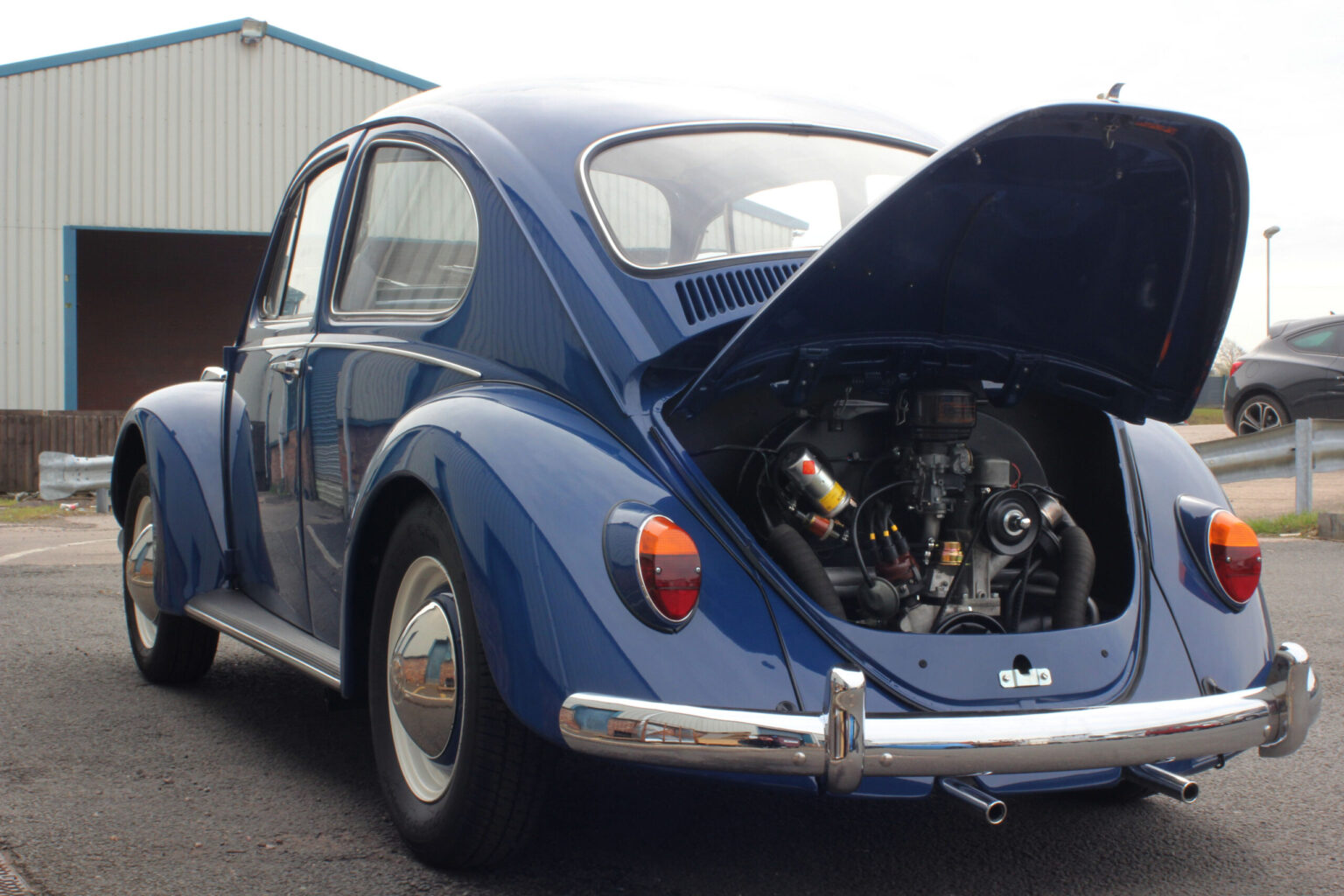
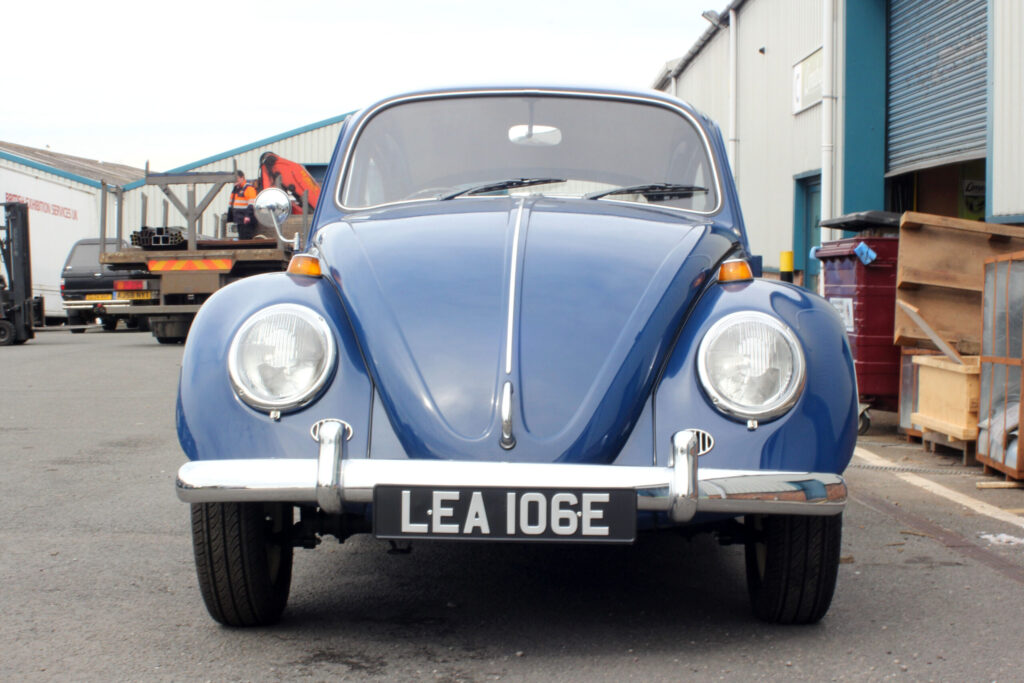
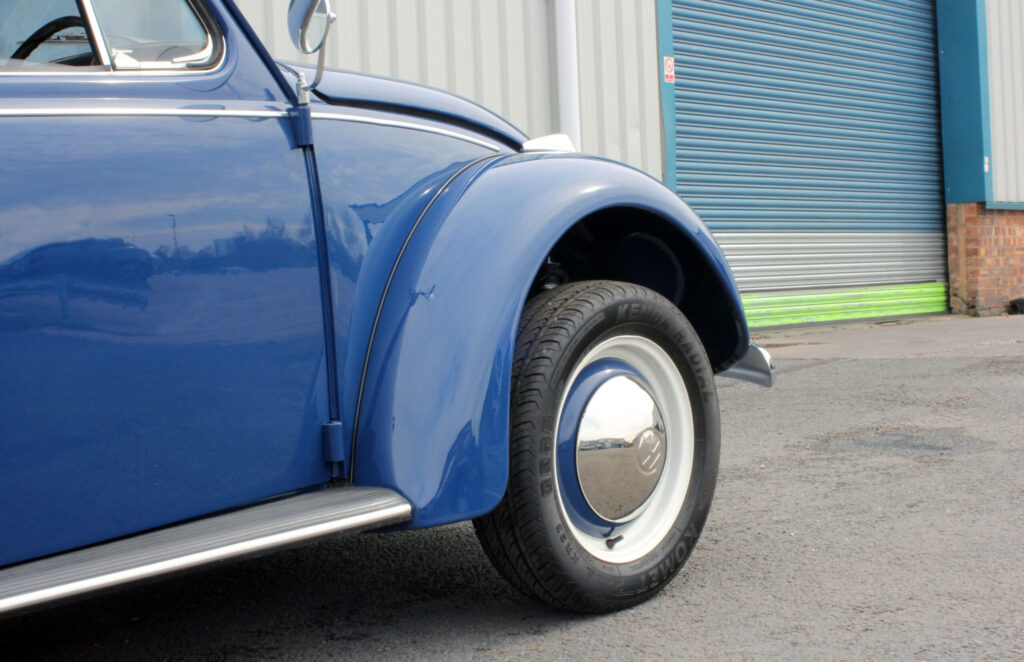
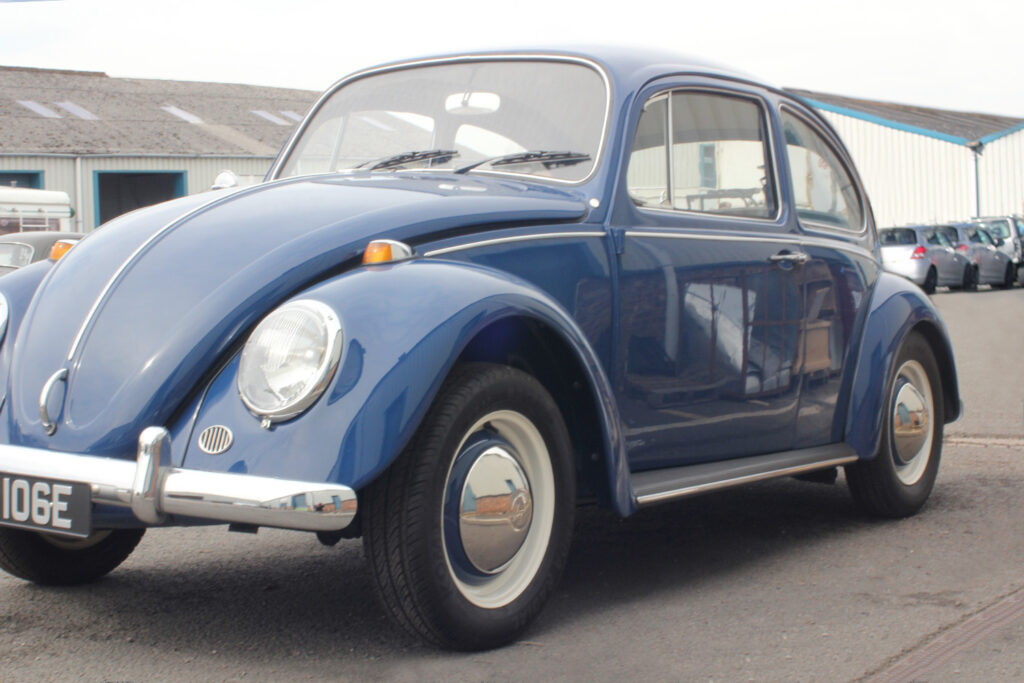
Limebug’s 1967 (Maria’s) Sparkafer Beetle is part of the Limebug Hall of Fame: a real-world build shared to show the stance, detail and finished result outside the product catalogue.
THE BLUE EXCEPTION
A tree growing through the engine bay. Nine years waiting for another chance. More than a year of secret evenings and weekends. Limebug’s 1967 Ultramarine Blue Sparkäfer went from being almost part of the landscape to a beautifully restored Volkswagen — built as a surprise for Craig’s mum.
Words by Limebug | Hall of Fame — Featured Builds
First, we had to cut down a tree.
We’ve tackled some fairly ambitious Volkswagen restorations over the years.
Cars with rotten floorpans. Cars missing half their bodywork. Cars that have spent so long sitting outside that the local wildlife has started treating them as permanent accommodation.
But this little 1967 Beetle presented a slightly different problem.
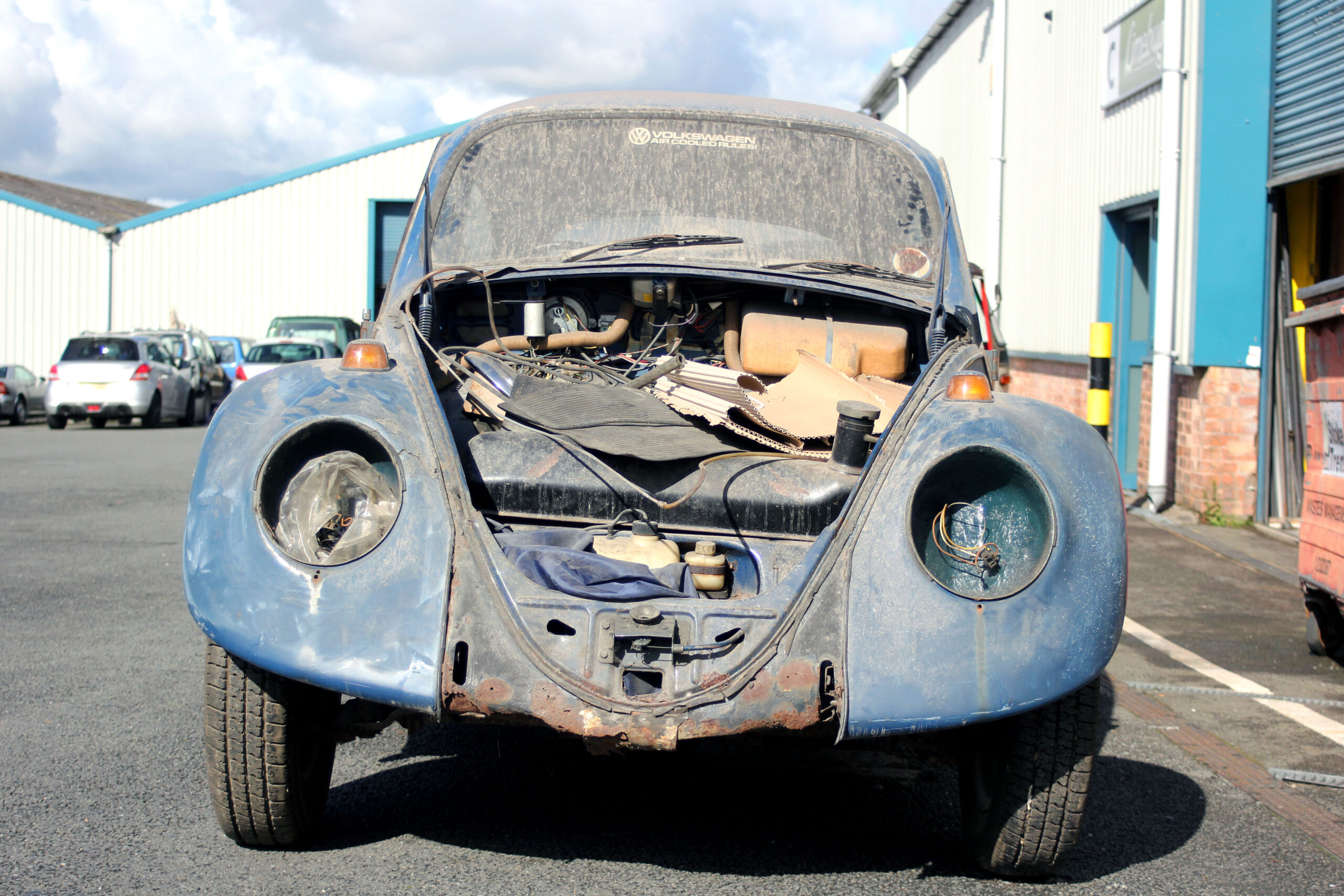
There was a tree growing through the engine bay.
Not a few weeds poking through the bumper irons.
Not a particularly enthusiastic shrub.
An actual tree.
It had grown to the point where the only way to move the Beetle was to cut it away.
Which tells you quite a lot about how long the poor thing had been sitting there.
For approximately nine years, the little Ultramarine Blue Sparkäfer had been waiting for somebody to give it another chance.
Nature, apparently, had other ideas.
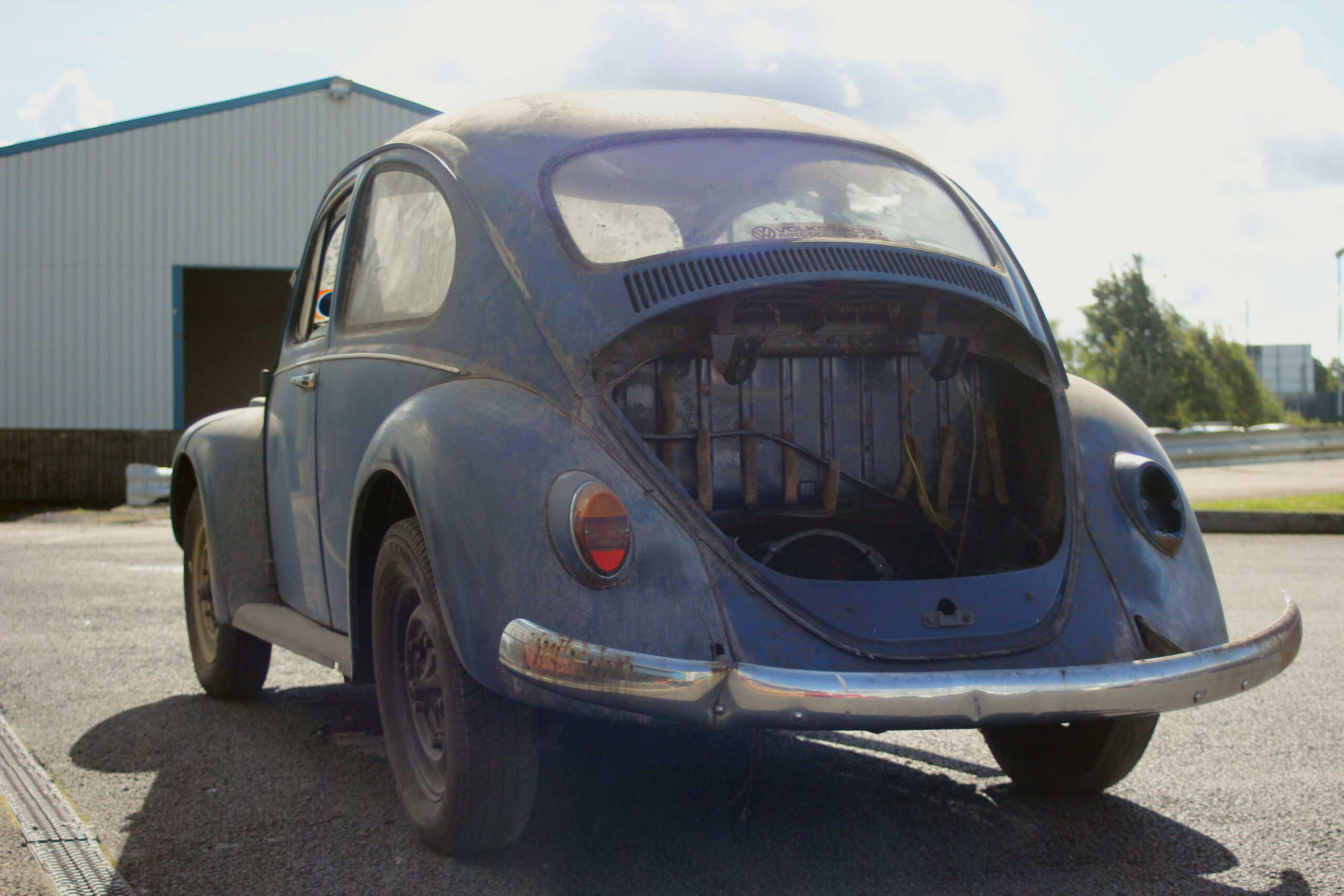
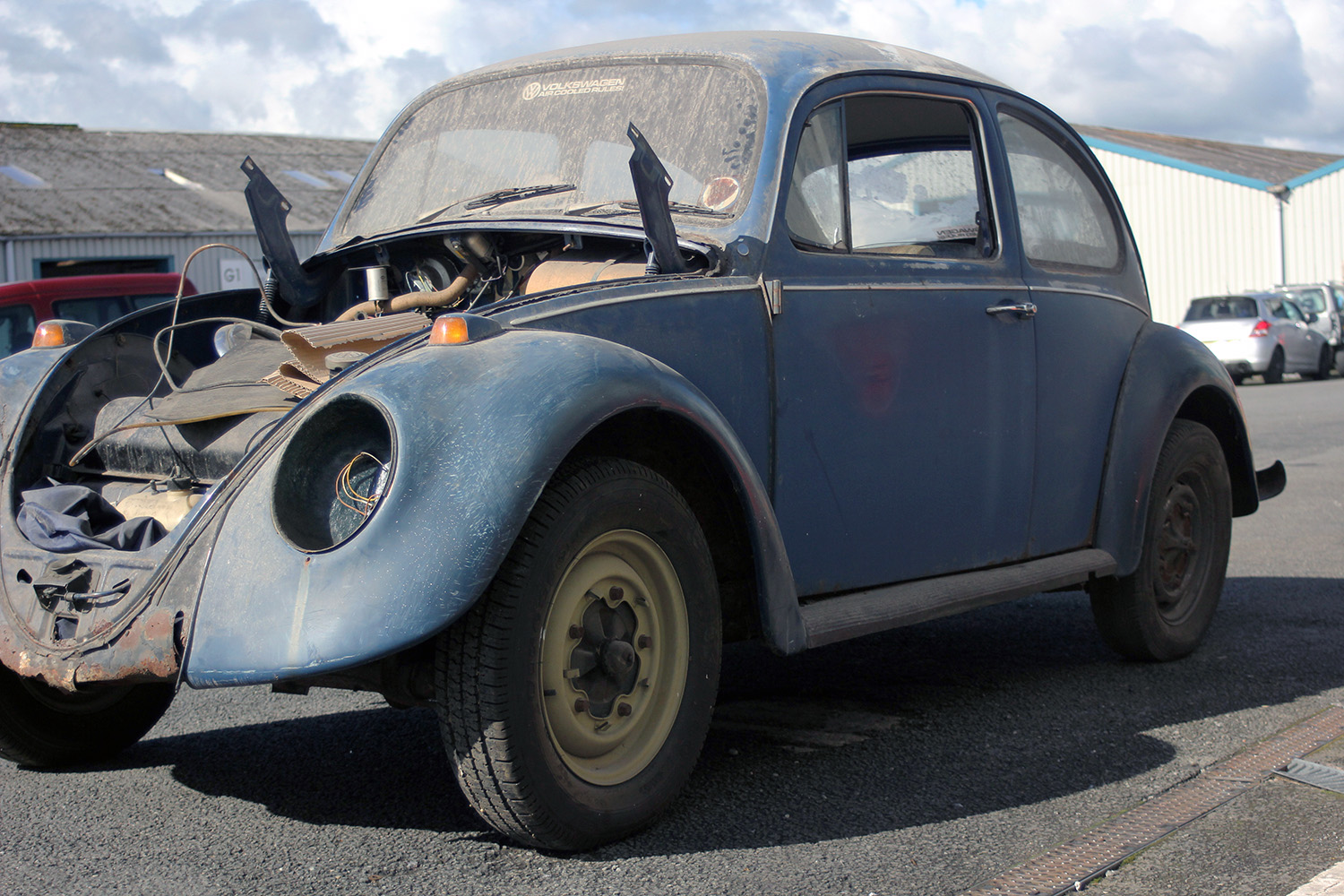
Looking at the photographs from before work began, you’d be forgiven for thinking we’d finally found a Volkswagen that was beyond saving.
But we had a rather special reason for bringing this one back.
Because this wasn’t being built for a customer.
It wasn’t destined to become another Limebug development vehicle.
And we had absolutely no intention of fitting air suspension.
We were restoring it in secret as a surprise for Craig’s mum.
Nine years waiting. One very good reason to start.
The Beetle that never quite got finished
Like so many old Volkswagens, the Sparkäfer had spent years sitting around waiting for its turn.
There were always other things to do.
Customer cars to finish.
Products to develop.
Orders to fulfil.
And the usual collection of jobs that somehow become more urgent than rescuing a neglected Beetle.
Meanwhile, the little blue Volkswagen continued its increasingly successful attempt to become part of the surrounding vegetation.
But beneath the neglect was something worth preserving.
A genuine 1967 Volkswagen 1200 Sparkäfer, retaining its original matching-number engine, gearbox, floorpan and body.
That was an important starting point.
Over the decades, plenty of Beetles have accumulated replacement engines, different floorpans, altered bodywork and components borrowed from whatever model happened to be available.
This one still retained the fundamentals of its original identity.
And we wanted to keep it that way.
A restoration nobody was supposed to know about
Once we’d decided to restore the car for Craig’s mum, the project became rather more complicated.
Keeping a complete Volkswagen rebuild secret isn’t particularly easy when you’re working in a busy engineering workshop.
Especially when the intended owner isn’t supposed to have the slightest idea what’s happening.
The solution was to carry out the restoration around our usual work.
Evenings.
Weekends.
And whatever spare hours we could find.
It wasn’t a project that could simply take over the workshop for a few uninterrupted months.
Instead, progress came in stages.
An evening repairing a panel.
A weekend sorting out another section of bodywork.
A few more hours spent cleaning, preparing and restoring components that probably hadn’t seen daylight for years.
In total, the restoration took a little over a year.
And considering the condition of the Beetle when we started, that was quite an achievement.
Saving a 1967, not just another Beetle
Metalwork. Everywhere.
Once we’d removed the vegetation and started dismantling the car, the full extent of the metalwork became clear.
There was plenty of it.
The years of neglect had taken their toll, and getting the little Sparkäfer back into proper shape would involve extensive cutting, repairing and fabrication.
But we had one very firm rule.
Retain as much of the original, year-specific 1967 steel as possible.
That might sound obvious.
But anybody who has restored an old Beetle will know that replacement panels aren’t always an exact reproduction of what Volkswagen fitted originally.
Pressings change.
Details disappear.
Mounting positions differ.
And apparently minor features can distinguish one particular model year from another.
The temptation is often to replace an entire section rather than spend hours repairing the original.
On this car, we deliberately took the longer route.
The difficult bits nobody notices
Particular attention went into the valance areas, the metalwork around the door handles and the original trim locations.
Instead of removing entire sections for convenience, repairs were carefully trimmed and worked around the surviving factory metal.
Original shapes were retained wherever possible.
Mounting points were preserved.
And the bodywork was repaired with the intention of keeping the Beetle recognisably correct for its year.
It was painstaking work.
The sort of job where you can spend an entire evening on something that occupies only a few inches of the finished car.
But those little details matter.
Especially on a vehicle like the Sparkäfer, where the original specification is comparatively simple.
With fewer decorative extras to distract the eye, the quality and accuracy of the bodywork become even more important.
The little Beetle with very little equipment
Meet the Sparkäfer
The Sparkäfer was Volkswagen’s more basic Beetle specification.
Simple transport, without many of the additional conveniences and decorative features found on the more luxurious versions.
And we were determined to preserve that character.
Not upgrade it.
Not quietly turn it into a Deluxe model.
And definitely not fill the interior with shiny accessories that would never have belonged there.
This meant paying attention to some wonderfully obscure details.
One sun visor. No radio. No nonsense.
For starters, there was no decorative chrome dashboard trim.
The steering wheel was the original basic design, without the chrome horn ring seen on more highly equipped Beetles.
There were no door-contact switches.
No radio.
And no aerial, with the original location remaining blanked off.
The headlining was the correct 1200-style arrangement.
And Volkswagen’s generosity extended to precisely one sun visor.
For the driver.
The passenger, presumably, was expected to appreciate the sunshine.
Even the smaller exterior and interior fittings were deliberately plain.
Painted wiper arms.
Painted door handles.
Painted window winders.
All details that could easily have been replaced with chrome during the restoration.
But that would have missed the point.
The absence of those luxuries wasn’t a problem to correct.
It was part of what made the car special.
Ultramarine Blue
Getting the bodywork right
After so many evenings of cutting, welding, fitting and carefully preserving the original metalwork, the Beetle was finally ready to return to its former appearance.
The colour was Ultramarine Blue.
And on a basic mid-sixties Beetle, it looks absolutely beautiful.
The rounded Volkswagen body has always suited simple, traditional colours, and the deep blue finish works particularly well against the Sparkäfer’s understated specification.
There was no need for elaborate graphics.
No contrasting roof.
No modern styling additions.
Just properly prepared bodywork, beautifully finished paint and the original details carefully returned to their correct positions.
The result was a complete transformation.
Especially when you remember that this was a car we’d initially had to cut free from a tree.
Just look at those before and afters
Seriously.
Look at the photographs.
The same car.
The same basic body.
But almost impossible to recognise.
Where there had once been years of accumulated neglect, there was now beautifully finished Ultramarine Blue paintwork.
Where original metal had been damaged, there were carefully executed repairs preserving the correct 1967 details.
And where the Beetle had spent years slowly surrendering to the elements, it now looked ready to leave the showroom.
The photographs of the car before and after restoration are among the most satisfying parts of the entire project.
Particularly the matching views.
They show what an enormous amount of work went into the restoration without needing a lengthy explanation.
Every panel gap, every preserved trim detail and every carefully repaired section contributes to the transformation.
And all of it was completed outside our normal working hours.
Matching numbers. Matching intentions.
The original 1200
As the restoration progressed, we continued to resist the temptation to modernise the car.
That included the mechanical specification.
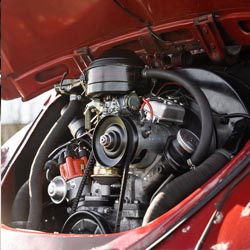
The Beetle retained its original matching-number 1200cc engine, gearbox, floorpan and body.
For a car of this age, retaining those major components was particularly important.
It preserved the vehicle’s history and allowed us to rebuild it around the identity it had carried since new.
The original 1200 engine might not offer particularly exciting performance by modern standards.
But it was exactly the right unit for the Sparkäfer.
Simple.
Dependable.
And entirely in keeping with the car’s original purpose.
There was no reason to replace it with a larger engine simply because we could.
For once, the objective wasn’t to improve on Volkswagen’s original specification.
It was to bring that specification back to life.
Keeping the standard suspension
The same approach applied to the running gear.
Which was an interesting experience for us.
Normally, a Beetle arriving at Limebug has at least some chance of leaving with a narrowed beam, air suspension or a collection of rather more elaborate mechanical components.
Not this time.
The original-style suspension arrangement stayed.
The ride height remained standard.
And the whole car was built around the modest, straightforward specification Volkswagen intended.
It’s probably one of the very few Beetles we’ve spent this much time working on without once deciding it needed to sit four inches lower.
There was one little exception.
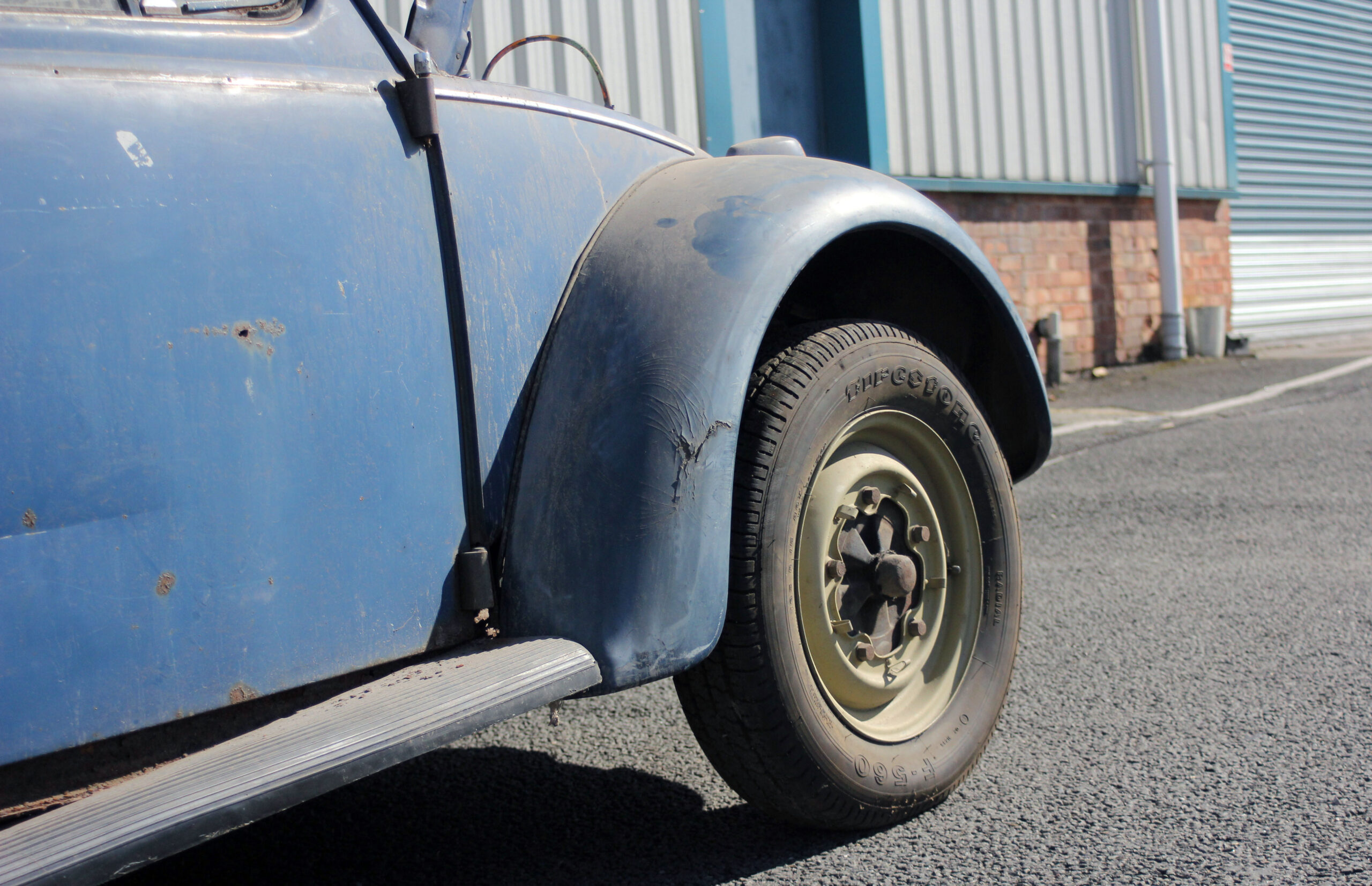
Those wheels had to go
Despite our best efforts, there was one part of the original appearance we couldn’t quite bring ourselves to keep.
The later-style vented steel wheels.
We’ve never been particularly fond of them.
And after spending so much time carefully restoring the bodywork, the thought of refitting those wheels just didn’t feel right.
So we made one small concession to personal preference.
A set of earlier-style domed smoothie steel wheels.
Their cleaner, simpler appearance suited the Ultramarine Blue bodywork beautifully.
They weren’t strictly correct for the car’s original specification.
But they were traditional Volkswagen wheels, and the visual difference was well worth it.
Other than that, the Sparkäfer remained remarkably faithful to its factory character.
No lowering.
No elaborate wheels.
No additional chrome.
Just a tiny deviation from the plan.
We thought we’d shown admirable restraint.
A little over a year in the making
The evenings added up
As the months passed, the little Beetle gradually came together.
The metalwork was completed.
The paintwork finished.
The original components carefully restored.
And the interior returned to its delightfully basic specification.
What had initially looked like an enormous undertaking became a complete, running and driving Volkswagen.
The restoration had taken a little over a year of evenings and weekends.
Time spent after the normal working day had finished.
Weekends that might otherwise have been spent doing something considerably more relaxing.
And an extraordinary number of small jobs completed simply because we wanted the finished car to be right.
But there was a very good reason for all that effort.
The best part was keeping it quiet
This wasn’t a commission.
It wasn’t an investment.
And it certainly wasn’t an excuse to demonstrate how many aftermarket parts we could fit to a 1967 Beetle.
It was a gift for Craig’s mum.
That meant every repaired panel, every original fitting and every evening spent working on the car contributed towards something much more personal.
A complete surprise.
And while the quality of the finished restoration mattered enormously, the reason for building it mattered even more.
VolksWorld 2018
A very different Limebug show car
The completed Sparkäfer made its public debut at VolksWorld 2018.
It was quite a departure from the type of vehicle people had come to associate with Limebug.
Surrounded by lowered Beetles, custom Volkswagens and elaborate mechanical conversions, the little blue 1200 looked almost suspiciously standard.
No air management system.
No massive wheel lips.
Not even a narrowed beam.
Just a beautifully restored basic Volkswagen.
And it looked right at home in the show hall.
For a car that had spent approximately nine years waiting to be rescued, it was a rather remarkable turnaround.
From sitting immobile with a tree growing through the back of it to appearing at one of Britain’s best-known Volkswagen shows.
The transformation was something we were immensely proud of.
Not because the car was particularly radical.
But because of how carefully it had been restored, and the reason we’d done it in the first place.
The complete build specification
Vehicle and history
- 1967 Volkswagen Type 1 Beetle
- 1200 Sparkäfer basic specification
- Ultramarine Blue
- Original matching-number engine, gearbox, floorpan and body
- Approximately nine years awaiting restoration
- Tree growing through the engine bay before recovery
- Secret restoration for Craig’s mum
- A little over one year of evenings and weekends
- VolksWorld 2018 debut
Bodywork and metal restoration
- Comprehensive nut-and-bolt restoration
- Extensive structural and cosmetic metalwork repairs
- Original year-specific 1967 steel retained wherever possible
- Detailed repairs around front and rear valance areas
- Original door-handle mounting areas carefully preserved
- Original trim locations and bodywork details retained
- Replacement metal carefully trimmed into surviving factory panels
- Ultramarine Blue exterior finish
Original Sparkäfer details
- Plain dashboard without chrome trim
- Original-style steering wheel without chrome horn ring
- No door-contact switches
- No radio
- Blanked-off aerial location
- Original 1200-style headlining
- Driver’s-side sun visor only
- Painted wiper arms
- Painted door handles
- Painted window winders
- Basic non-Deluxe specification throughout
Mechanical specification
- Original matching-number 1200cc engine
- Original matching-number gearbox
- Original floorpan
- Original body
- Factory-style suspension and ride height
- Original mechanical character retained
Wheels
- Earlier-style domed smoothie steel wheels
- Fitted in place of the original-style vented steel wheels
The one we’ll always remember.
We’ve built plenty of unusual Volkswagens over the years.
Some have taken thousands of hours.
Others have involved complicated engineering, bespoke suspension systems and components that didn’t exist until we decided to make them.
But the little blue Sparkäfer will always mean something different.
There was no elaborate modification programme.
No major engineering experiment.
And no attempt to create the most dramatic car at a show.
Instead, we spent more than a year carefully restoring a Volkswagen that had been neglected for so long a tree had grown through its engine bay.
We repaired the metalwork.
Preserved the original 1967 details.
Kept the matching-number components together.
And resisted almost every opportunity to modify it.
All while keeping the entire project secret.
Because this one wasn’t about showing what Limebug could do.
It was about building something special for someone special.
Nine years waiting. A year of secret work. One very special surprise.
The Blue Exception. Built by Limebug. For Craig’s mum.
And yes.
We still think the smoothie wheels look better.