
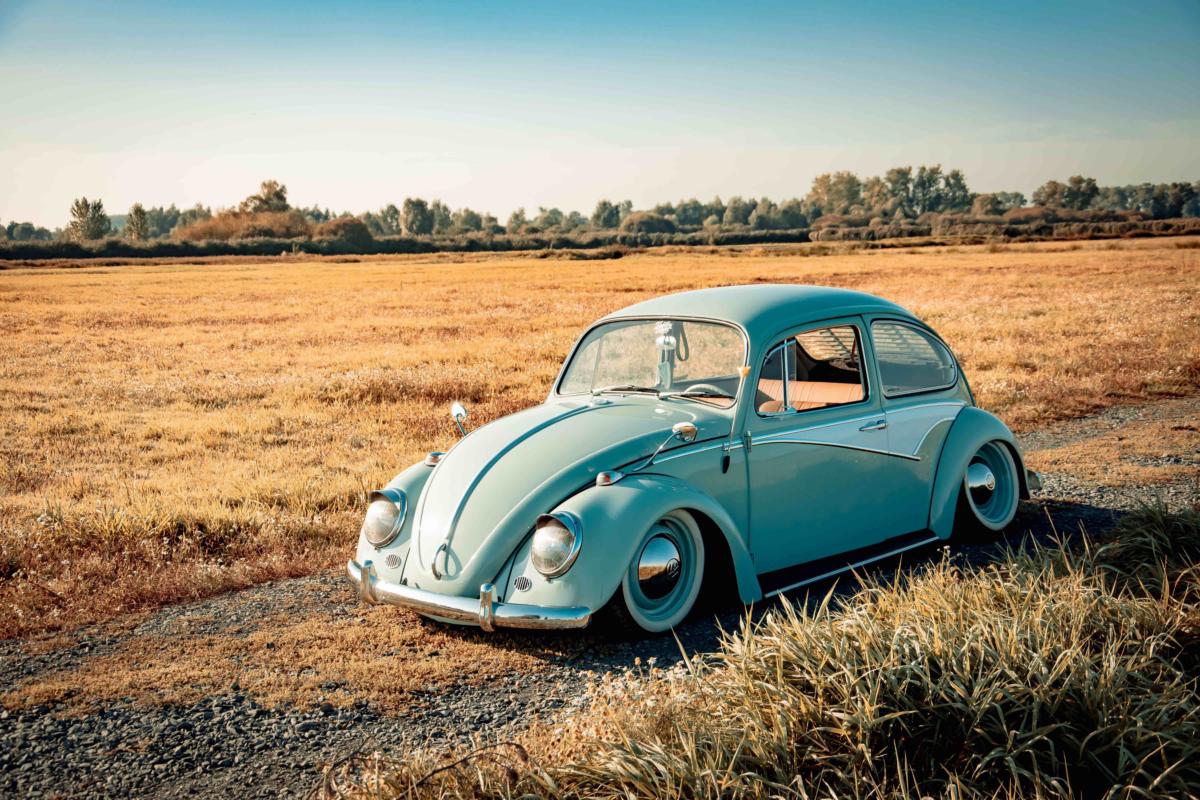
Nick B’ Beetle puts a real-world finish on the Limebug catalogue, bringing together 1948-65 Beetle / Ghia 4" Narrowed Link Pin Deluxe Cantilever Swing Axle / IRS Air Ride Kit, 1948-79 Beetle / Ghia "The Revolution" Cantilever Swing Axle / IRS Rear Air Ride Kit, Bolt on, 1948-65 Beetle / Ghia Link Pin 4" Narrowed Complete Front Air Ride Kit with Elite Series Jawbreaker Beam in one properly resolved setup.
BAHAMA DRAMA
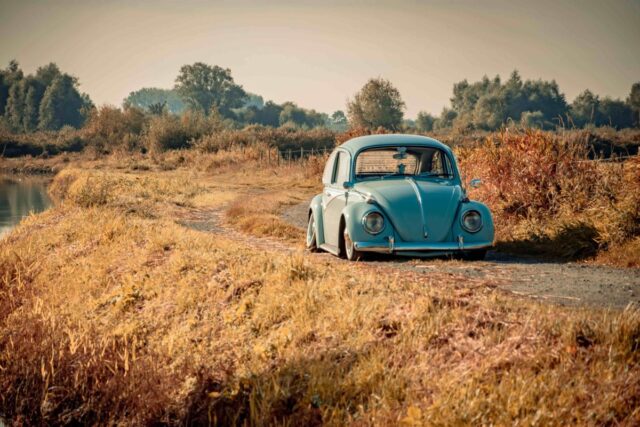
Bahama Blue paint, hand-crafted Australian trim, widened steel wheels and a complete Limebug Deluxe air suspension system. Nick Bruynooghe’s 1965 Beetle 1200 might look like a gentle old Volkswagen at first glance, but this Belgian-built beauty has a rather different attitude when the air comes out.
Words by Limebug | Hall of Fame — Featured Builds
Thirty-five horsepower. Absolutely no ground clearance.
There’s a rather wonderful contradiction in the world of modified Volkswagens.
You can spend thousands building a serious engine, fit enormous brakes, upgrade the gearbox and turn an innocent-looking Beetle into something capable of embarrassing considerably newer machinery.
Or you can leave the engine completely alone, spend your time getting everything else just right, and create a car that attracts just as much attention.
Nick Bruynooghe went for the second option.
His 1965 Beetle 1200 still runs its modest factory-specification flat-four, retains the original gearbox and stops using the same drum brakes Volkswagen fitted more than half a century ago.
But take one look at the ride height and you’ll realise that originality wasn’t necessarily the priority everywhere.
Because this Bahama Blue Bug sits seriously low.
And underneath that beautifully restrained exterior is a complete Limebug Deluxe air suspension setup.
It’s an unusual combination.
Traditional styling, carefully chosen accessories, a beautifully retrimmed interior and a stance that makes you wonder whether somebody has accidentally let all the air out of the tyres.
For Nick, though, it’s exactly the point.
A young enthusiast. An old Volkswagen.
From Lichtervelde, with love
When Nick’s Beetle appeared in the European motoring press, he was just 26 years old.
The car itself was considerably older.
Built in 1965, the Volkswagen had already passed its half-century by the time the Belgian electrician began making his mark on it.
Nick lives in Lichtervelde, a town in West Flanders, not far from Bruges.
It’s a part of Europe with a healthy enthusiasm for classic Volkswagens, and Nick’s Beetle is a particularly good example of how the air-cooled scene continues to attract younger owners.
There’s no need for a modern engine conversion or a wholesale reinvention of the car.
Instead, Nick concentrated on the details.
The right colour.
The right trim.
The right wheels.
And, naturally, getting the thing as close to the ground as possible.
The result is a car that looks familiar from a distance but becomes considerably more interesting the closer you get.
The blue that does the talking
Bahama Blue and a little Australian influence
The Beetle’s Bahama Blue paintwork is a big part of its appeal.
It’s a colour that suits the mid-sixties body perfectly, giving the car a soft, traditional appearance that contrasts beautifully with the more extreme suspension setup.
But Nick wasn’t content to leave the exterior entirely standard.
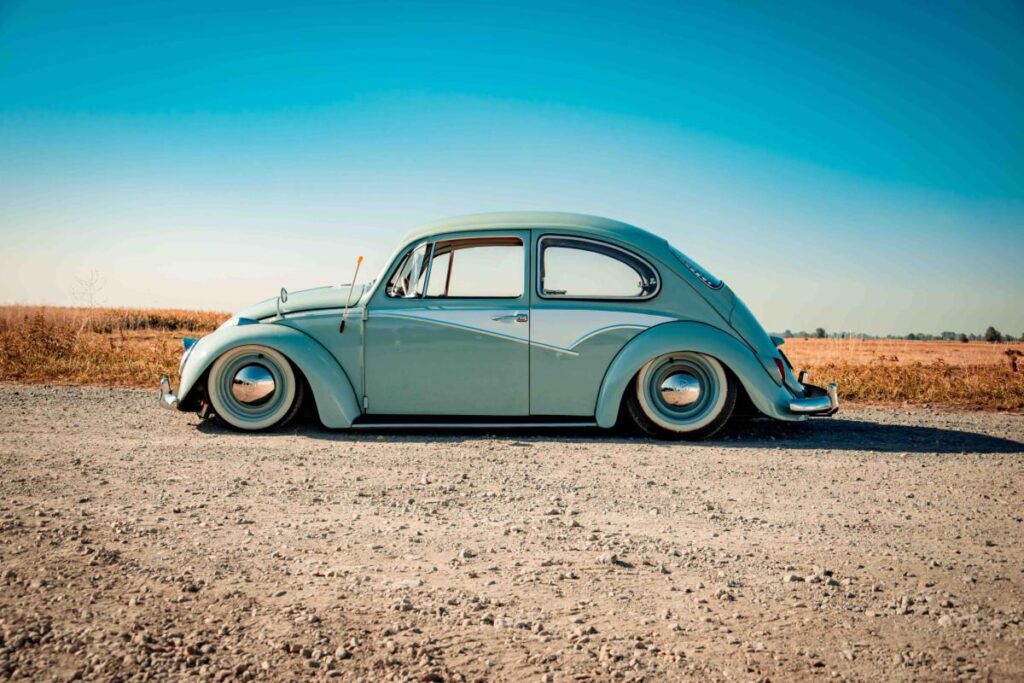
One of the most distinctive modifications is the Australian-style side trim.
Rather than simply fitting an off-the-shelf accessory, Nick made the arrangement himself.
Three chrome strips run along the body, framing a contrasting white section against the blue paintwork.
It’s a clever addition.
The white panels visually break up the large curved sides of the Beetle, while the chrome strips create a much more elaborate profile than the standard factory trim.
And because the whole arrangement follows the car’s original shape, it looks remarkably at home.
It’s the sort of modification that makes people stop and wonder whether they’re looking at an obscure factory specification.
Which, for a custom detail, is quite a compliment.
All the little things
The rest of the exterior follows a similarly traditional theme.
Headlight visors add a little extra character to the front end.
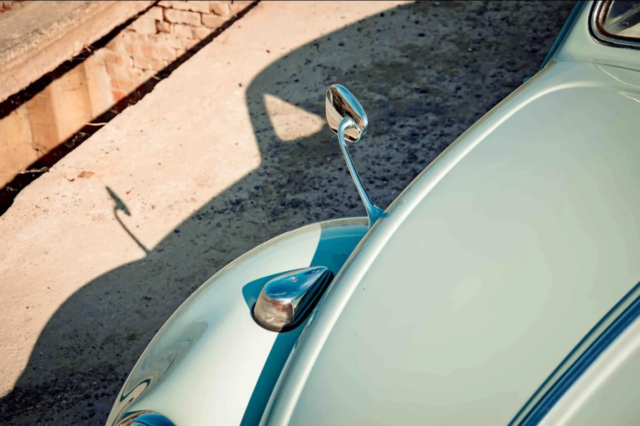
Gooseneck mirrors provide a distinctly vintage touch.
Original-style triangular vent windows have been retrofitted into the doors.
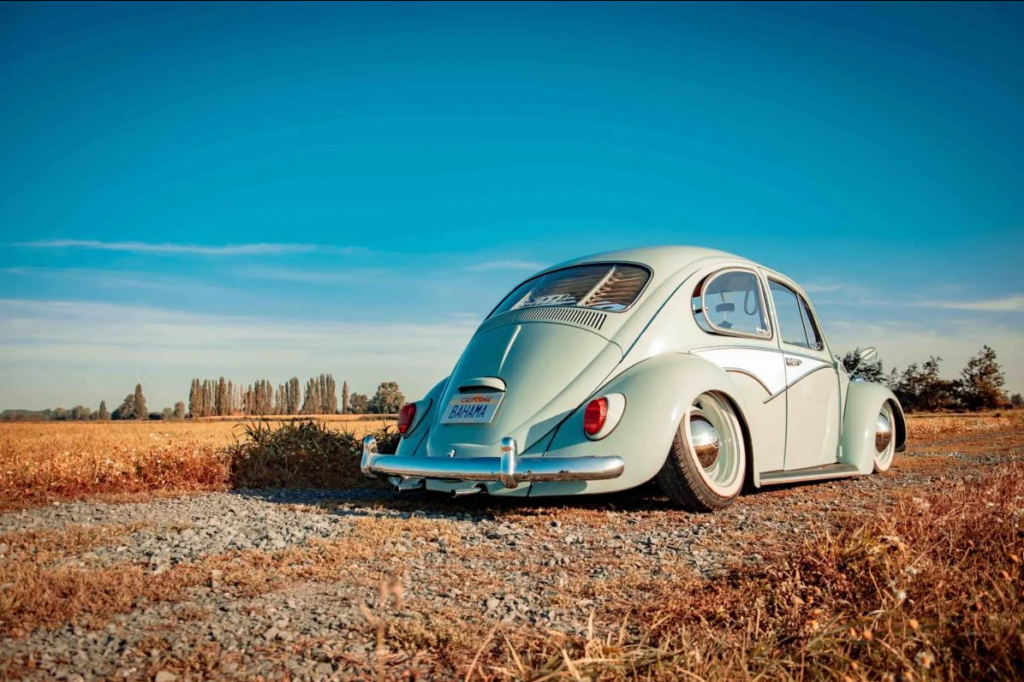
And at the rear, all-red American-style tail-light lenses introduce another subtle departure from the European specification.
There’s even a Mooneyes Shaka antenna accessory.
None of these details is particularly outrageous in isolation.
But together they give the Beetle a wonderfully individual appearance.
It’s the kind of build where the longer you look, the more you notice.
And then your eyes drop to the wheels.
Which is where things become rather less subtle.
The Limebug treatment
Low. Then lower.
The biggest transformation to Nick’s Beetle came courtesy of a complete Limebug Deluxe air suspension system.
It’s the modification that changes the whole character of the car.
At a more conventional ride height, the Bahama Blue 1200 could almost pass for a lightly customised classic.
But aired out, the body settles dramatically towards the ground, the wheels disappear further into the arches and the Beetle takes on a completely different personality.
The system uses twin compressors and an air tank finished in the same Bahama Blue as the body.
And rather than cluttering the dashboard with additional equipment, Nick integrated the controls into the glovebox.
The gauges and control levers are mounted on a specially finished panel, also painted to match the exterior.
It’s a particularly tidy installation.
Open the glovebox and the air suspension controls are right there.
Close it and the interior returns to its largely traditional appearance.
A neat little detail that says quite a lot about the thought behind the build.
Widened steels and wild camber
Factory wheels, different proportions
Plenty of owners fitting air suspension to a Beetle immediately reach for a set of aftermarket alloys.
Nick took a more traditional route.
The car retains original-style Volkswagen steel wheels.
But they’re not all quite as Volkswagen intended.
At the front, the wheels remain a relatively modest 4×15 inches, wearing 145/65 R15 tyres.
At the rear, the steel rims have been widened to 6×15 inches, with 175/65 R15 tyres.
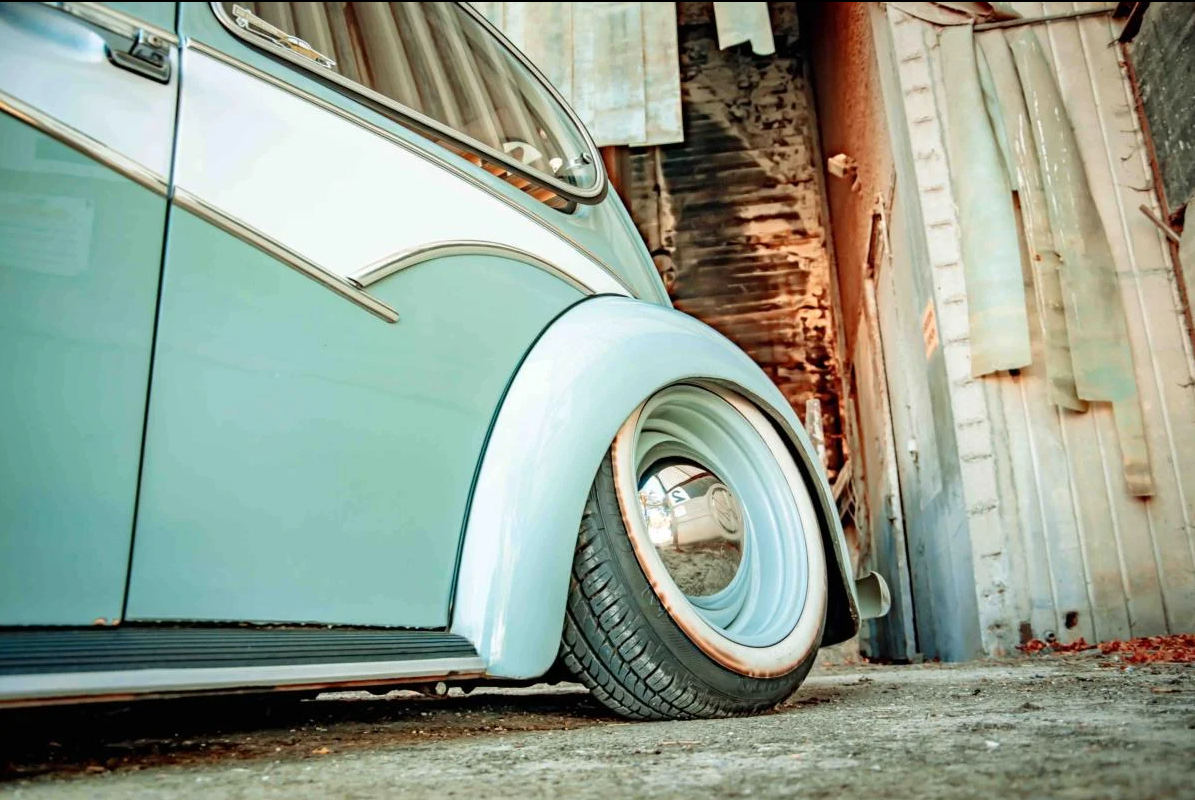
The combination is completed by 25mm rear spacers and Atlas whitewall tyres.
It’s a brilliant look.
The whitewalls complement the contrasting side trim, while the widened rear wheels give the car a little more visual weight without introducing an obviously modern wheel design.
Then there’s the rear camber.
With the swing-axle suspension sitting so low, the rear wheels take on an extremely pronounced negative angle.
It’s a look that divides opinion.
Some people love it.
Others will spend the next twenty minutes explaining why they don’t.
But on Nick’s Beetle, there’s no denying the visual impact.
The rear wheels tuck beneath the arches, the whitewalls lean inwards and the whole car takes on the unmistakable appearance of a heavily lowered swing-axle Volkswagen.
Combined with the Limebug suspension, it’s one of the defining features of the build.
Brown vinyl done properly
A little Dutch craftsmanship
If the exterior is an exercise in traditional styling with an extreme stance, the interior is where Nick really indulged in the details.
The retrim was carried out by Klaassens Customs, based in Mierlo in the Netherlands.
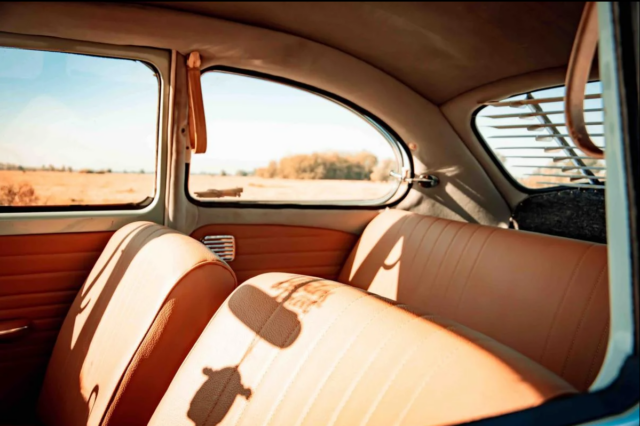
And rather than going for a stark or minimalist approach, the cabin received a rich brown vinyl finish.
The seats, door cards and rear side panels were all retrimmed, with matching brown carpeting completing the look.
It’s a particularly effective contrast against the Bahama Blue exterior.
Warm, traditional and entirely appropriate for a mid-sixties Beetle.
The craftsmanship gives the cabin a much more finished appearance than simply fitting a set of replacement seat covers.
And the details don’t stop there.
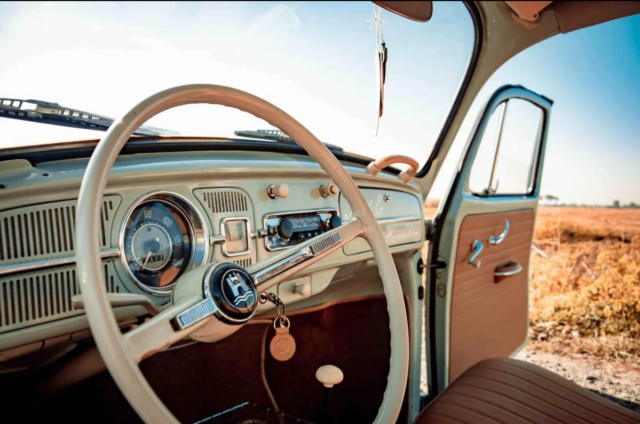
Beneath the dashboard sits a chrome basket with integrated cupholders.
There’s also a sunshade positioned ahead of the rear window.
Both are wonderfully period-inspired accessories that suit the car’s character without making the interior feel overcrowded.
The overall impression is of a classic Volkswagen cabin that’s been carefully personalised rather than completely redesigned.
The original soundtrack
One of the nicest details is the radio.
Nick retained the original Blaupunkt Frankfurt S, which was reported to be in full working order.
No oversized touchscreen.
No modern entertainment system dominating the dashboard.
Just a proper period radio sitting exactly where it belongs.
And with the air suspension controls tucked away inside the glovebox, there’s very little to distract from the original Beetle atmosphere.
It’s a lovely contrast.
A cabin that feels as though it belongs in 1965.
With suspension technology that very definitely doesn’t.
Thirty-five horses and no hurry
The 1200 stays
Now for the bit that might surprise anyone expecting a serious performance build.
The engine is essentially standard.
Nick’s Beetle retains its 1.2-litre air-cooled flat-four, producing approximately 34–35hp.
The engine received a thorough clean and some attention to damaged engine-bay sheet metal, but the mechanical specification was otherwise left largely alone.
No twin carburettors.
No big-bore conversion.
No attempt to turn the little 1200 into something it was never designed to be.
And that’s absolutely fine.
Because this particular Beetle was never about outright speed.
It’s about enjoying the car, appreciating the details and making the most of the driving experience.
The original four-speed manual gearbox remains, along with drum brakes at all four corners.
It’s a fairly straightforward mechanical package.
The sort of simple Volkswagen engineering that helped make the Beetle so popular in the first place.
And in a car with this much visual personality, 35 horsepower is more than enough to get people looking.
Even if it takes a little longer to get anywhere.
The build specification
Vehicle
- 1965 Volkswagen Beetle 1200
- Owner: Nick Bruynooghe
- Location: Lichtervelde, Belgium
- Bahama Blue paintwork
- Original 1.2-litre drivetrain retained
Exterior
- Custom Australian-style three-strip chrome side trim
- Contrasting white side panels
- Retrofitted original-style triangular vent windows
- Headlight visors
- Gooseneck mirrors
- All-red American-style rear light lenses
- Mooneyes Shaka antenna accessory
Limebug suspension
- Complete Limebug Deluxe air suspension
- Twin compressors
- Body-coloured air tank
- Glovebox-mounted gauges and control levers
- Custom Bahama Blue control mounting panel
- Adjustable front and rear ride height
Wheels and tyres
- Front: original-style 4×15-inch steel wheels
- Rear: widened 6×15-inch steel wheels
- Front tyres: 145/65 R15
- Rear tyres: 175/65 R15
- 25mm rear wheel spacers
- Atlas whitewall tyres
- Pronounced negative rear camber
Interior
- Custom retrim by Klaassens Customs, Mierlo, Netherlands
- Brown vinyl seat upholstery
- Matching brown door cards and rear side panels
- Brown carpeting
- Chrome under-dash basket with cupholders
- Rear-window sunshade
- Original Blaupunkt Frankfurt S radio
- Concealed air suspension controls in glovebox
Engine and drivetrain
- 1,192cc air-cooled flat-four
- Approximately 34–35hp
- Standard four-speed manual gearbox
- Original front and rear drum brakes
- Engine cleaned and engine-bay sheet metal repaired
A little blue goes a long way
There are plenty of ways to build a modified Beetle.
You can chase horsepower, hunt down rare accessories or spend years creating a completely bespoke body.
Nick Bruynooghe took a different approach.
He started with a lovely old 1965 Volkswagen and concentrated on making the details work together.
The Bahama Blue paint.
The hand-crafted Australian trim.
The widened steel wheels and whitewall tyres.
The beautifully retrimmed brown interior.
And the complete Limebug Deluxe air suspension system that allows the whole car to settle into an almost impossibly low stance.
What makes the build particularly appealing is that none of those modifications demands a complete departure from the Beetle’s original identity.
It’s still a 1200.
Still running a modest little flat-four.
Still shifting through its original four-speed gearbox.
And still relying on the same basic mechanical formula that made Volkswagen famous.
It just happens to sit rather closer to Belgium’s roads than Ferdinand Porsche probably had in mind.
Nick Bruynooghe’s 1965 Beetle. Bahama Drama.